
If you scheduled one fall cleanup and called it done, your gutters are probably already clogged again. Gutter cleaning in Peoria isn’t a one-and-done job in autumn because the city’s tree canopy doesn’t drop its leaves on one schedule — it drops on two. Maples let go first, usually by early-to-mid October, and oaks hold on for weeks longer, sometimes into late November or even December. One cleaning catches half the problem and leaves the other half sitting in your gutters all winter.
Table of Contents
Gutter Cleaning Peoria Homeowners Actually Need: Two Passes, Not One
Quick Answer: How many times should you clean your gutters in fall in Peoria? Most homes with a mixed oak-maple canopy need two cleanings — one in early-to-mid October after maple, ash, and elm leaves come down, and a second in mid-to-late November once oak leaves finally release. Skipping the second pass is the single biggest reason Peoria homeowners deal with ice dams, overflow staining, and fascia board rot every winter.
This isn’t a Peoria-specific quirk of nature, but it does hit local homeowners harder than it does in regions with a single dominant tree species. According to University of Illinois Extension’s tree research, maples and sweet gums typically develop color and drop earlier in the season, while many native Illinois oaks hold their leaves considerably longer — a pattern that plays out block by block across Peoria’s older, tree-lined neighborhoods.
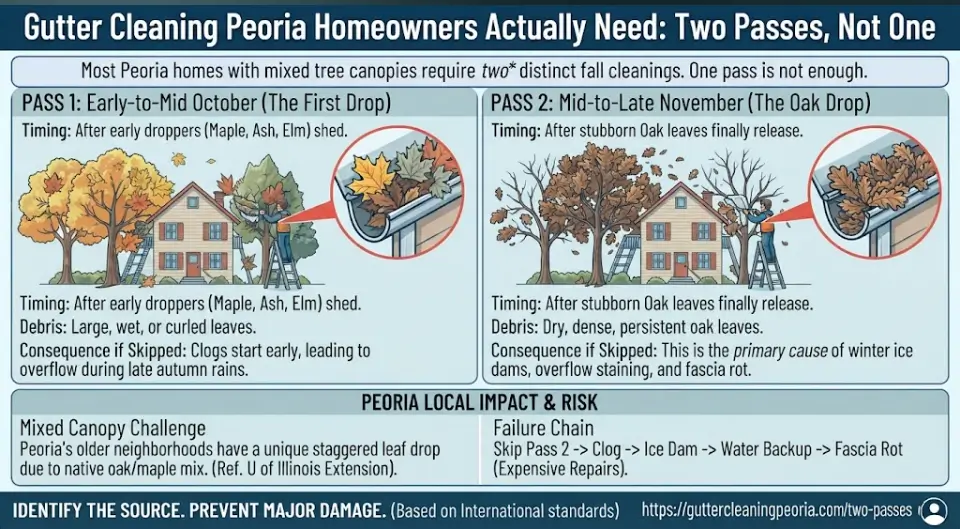
Wave One: The Maple and Ash Drop (Early to Mid-October)
Silver maples, red maples, and ash trees are common street and yard trees throughout Peoria, and they’re early droppers. Once nighttime temperatures start dipping into the 40s, these trees can shed most of their canopy in a one-to-two week window. Because the leaves are smaller and drier than oak leaves, they pack tightly into gutter channels and downspout openings, forming a mat that water simply sheets over instead of draining through.
If your gutters back up after a heavy October rain and you can see standing leaves rather than flowing water, that’s wave one already doing damage. Left in place, this early leaf pack holds moisture against the fascia board for weeks, which is exactly the setup that leads to fascia board rot and paint blistering along the roofline.
Wave Two: The Oak Holdout (Mid-November Through Early December)
Peoria’s white oaks, red oaks, and pin oaks are notoriously slow to let go. Many oak leaves don’t detach until a hard freeze forces the issue, which in central Illinois often doesn’t arrive until late November. Homeowners who cleaned their gutters once in October and assumed they were set for winter frequently find a second, heavier layer of oak leaves packed on top of the first by Thanksgiving.
Oak leaves are larger, leathery, and slower to break down than maple leaves, so they don’t just clog gutters — they trap water against the roof edge and add significant weight. A gutter run full of wet oak leaves can hold hundreds of extra pounds, which stresses fasteners and hangers and is a common cause of gutters pulling away from the fascia mid-winter.
What Happens When You Skip the Second Cleaning
Skipping the November cleanup doesn’t just mean clogged gutters — it sets up a chain of problems that show up later in winter, when they’re harder and more expensive to fix:
- Ice dams: Trapped leaves hold snowmelt at the roof edge. When temperatures swing below freezing overnight, that water refreezes into an ice dam that backs water up under shingles.
- Fascia board rot: Standing water and wet leaf debris sit against wood trim for months, accelerating rot that eventually requires carpentry repair, not just a cleaning.
- Water damage to siding and foundation: Overflowing gutters push water directly down exterior walls and pool at the foundation instead of routing away through downspouts.
- Downspout realignment issues: Compacted leaf debris freezes solid inside downspouts, sometimes forcing sections out of alignment when the ice expands.
- Pest activity: Damp, decomposing leaf matter in a clogged gutter is an attractive nesting spot for mosquitoes in fall and rodents looking for winter shelter.
Seamless gutters reduce leak points at the seams, but they don’t prevent clogging — even a well-installed seamless gutter system needs both fall cleanings to function correctly through a Peoria winter.
Signs Your Gutters Need Attention Before Winter Hits
- Visible leaf buildup or “green sprouts” growing in the gutter trough
- Water pouring over the gutter edge during rain instead of through the downspout
- Sagging gutter sections or visible pulling away from the fascia
- Staining or streaking on siding below the gutter line
- Water pooling near the foundation after rainfall
- A musty smell near the roofline, which often signals trapped moisture
If you’re noticing two or more of these, your gutters need a cleaning now, not in spring.
Peoria’s Freeze-Thaw Cycle Makes Timing Non-Negotiable
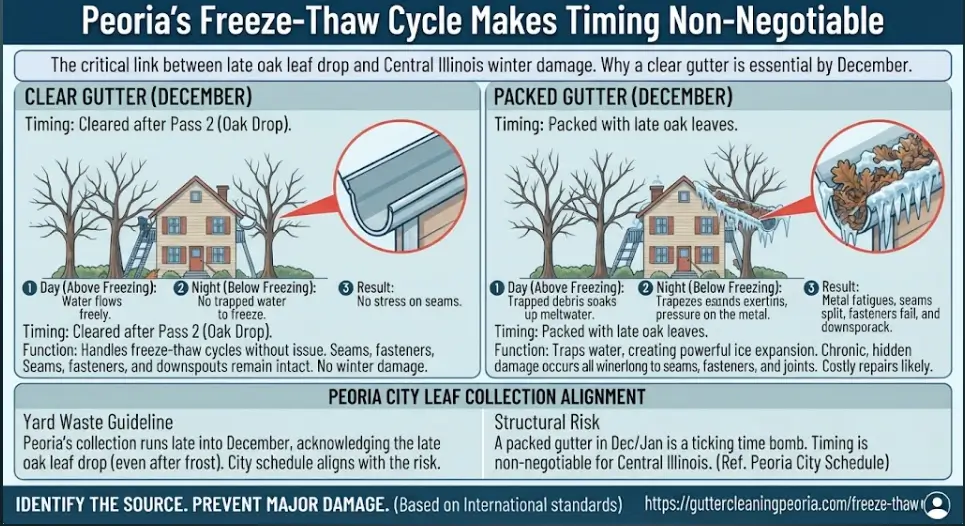
Central Illinois winters swing between freezing nights and above-freezing days more often than the coldest northern states, and that freeze-thaw cycle is what turns a clogged gutter into a structural problem. Every refreeze expands trapped water, stressing seams, fasteners, and downspout joints a little more each cycle. A gutter that’s clear going into December handles that cycle fine. A gutter still packed with November’s oak leaves takes on damage all winter long, even if nobody’s climbed a ladder to see it.
The city’s own yard waste and leaf collection guidelines reflect this same two-wave pattern — Peoria’s collection calendar runs well into December specifically because the later oak drop keeps generating yard waste long after the first hard frost.
When to Book Both Cleanings
For most Peoria homes with a mixed canopy, the practical schedule looks like this:
- First cleaning: Early-to-mid October, right after the bulk of maple and ash leaves are down.
- Second cleaning: Mid-to-late November, after the first hard freeze knocks down the oak holdouts.
Homes surrounded mostly by oaks can sometimes get away with pushing the first cleaning later. Homes with heavy maple cover but few oaks may only need one cleaning if their neighbors’ oaks aren’t overhanging the roofline. A quick visual check of the surrounding tree canopy tells you which schedule fits your property — or you can have it assessed directly rather than guessing.
Homeowners across the area rely on gutter cleaning services in Peoria to handle both fall passes so the timing doesn’t slip past the point where debris has already started causing damage. Whether you need one seasonal visit or two, getting on the schedule before the second leaf wave hits is what keeps a routine cleaning from turning into a repair call.
FAQs
How often should gutters be cleaned in the fall in Peoria?
Most Peoria homes with both maple and oak trees nearby need two fall cleanings — one in early-to-mid October and one in mid-to-late November. Homes with only one tree type overhead may only need a single visit.
Why do my gutters clog again right after I just cleaned them?
This is almost always the second leaf wave. If maples cleared out in October but there are oaks on your block or a neighbor’s property, those leaves are still coming down weeks later and will refill a freshly cleaned gutter.
Does gutter cleaning prevent ice dams?
Yes, in large part. Ice dams form when trapped debris and standing water refreeze at the roof edge. Clear gutters drain freely instead of holding water, which removes the main condition that allows ice dams to form.
What’s the difference between a downspout clog and a gutter clog?
A gutter clog sits in the horizontal trough and usually shows as standing leaves or overflow along the roofline. A downspout clog is deeper inside the vertical pipe and shows as water backing up at the top of the downspout even when the gutter trough itself looks clear.
Are seamless gutters less likely to clog with leaves?
Seamless gutters reduce leak-prone joints along the run, but the trough still fills with leaves the same way a sectional gutter does. Seamless construction doesn’t replace the need for cleaning — it just removes one separate source of leaks.
Can hard water or mineral buildup affect gutters?
Gutters are less affected by hard water than dishwashers or washing machines, but standing water left in a clogged gutter over winter does accelerate rust on metal fasteners and hangers, which is another reason to keep the trough draining freely.
How do I know if I need gutter guards instead of just cleaning?
Gutter guards reduce debris intake but don’t eliminate the need for maintenance, especially with oak leaves, which are small enough to work past most guard systems. Guards work best as a supplement to a fall cleaning schedule, not a replacement for it.
Is it too late to clean gutters in December?
It’s better late than not at all, but once a hard freeze locks debris in place, a cleaning becomes more difficult and any water already trapped may have already caused some damage. Booking the second cleaning before the first sustained freeze avoids this.