
By the Gutter Cleaning Peoria team · Updated November 17, 2026
Short answer: An underground downspout drain is probably clogged if water spills out where the downspout enters the buried pipe, one gutter corner overflows in every storm, the pop-up emitter in the yard never opens, or the soil over the pipe stays soggy. Test it by running a hose into the drain. If water backs up, clear the gutter and downspout first, then flush or snake the buried pipe. Crushed or root-filled pipe needs to be dug up and replaced.
Many homes in Peoria, from older streets in the West Bluff and Uplands to newer subdivisions in Dunlap, Peoria Heights and Pekin, send downspout water into buried pipes. When those pipes work, the yard looks clean and water ends up well away from the foundation. When they clog, the water has nowhere to go, and it often ends up right next to the house. This guide explains the signs, how to test and clear the line, and when to replace it.
What are the signs of a clogged underground downspout drain?
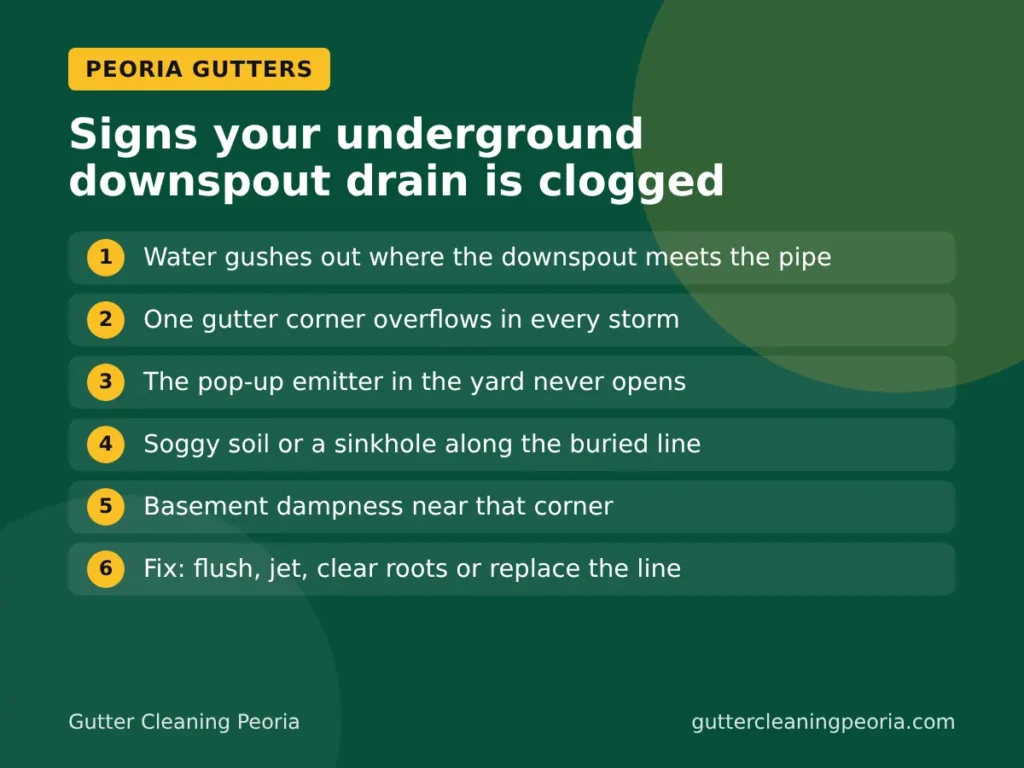
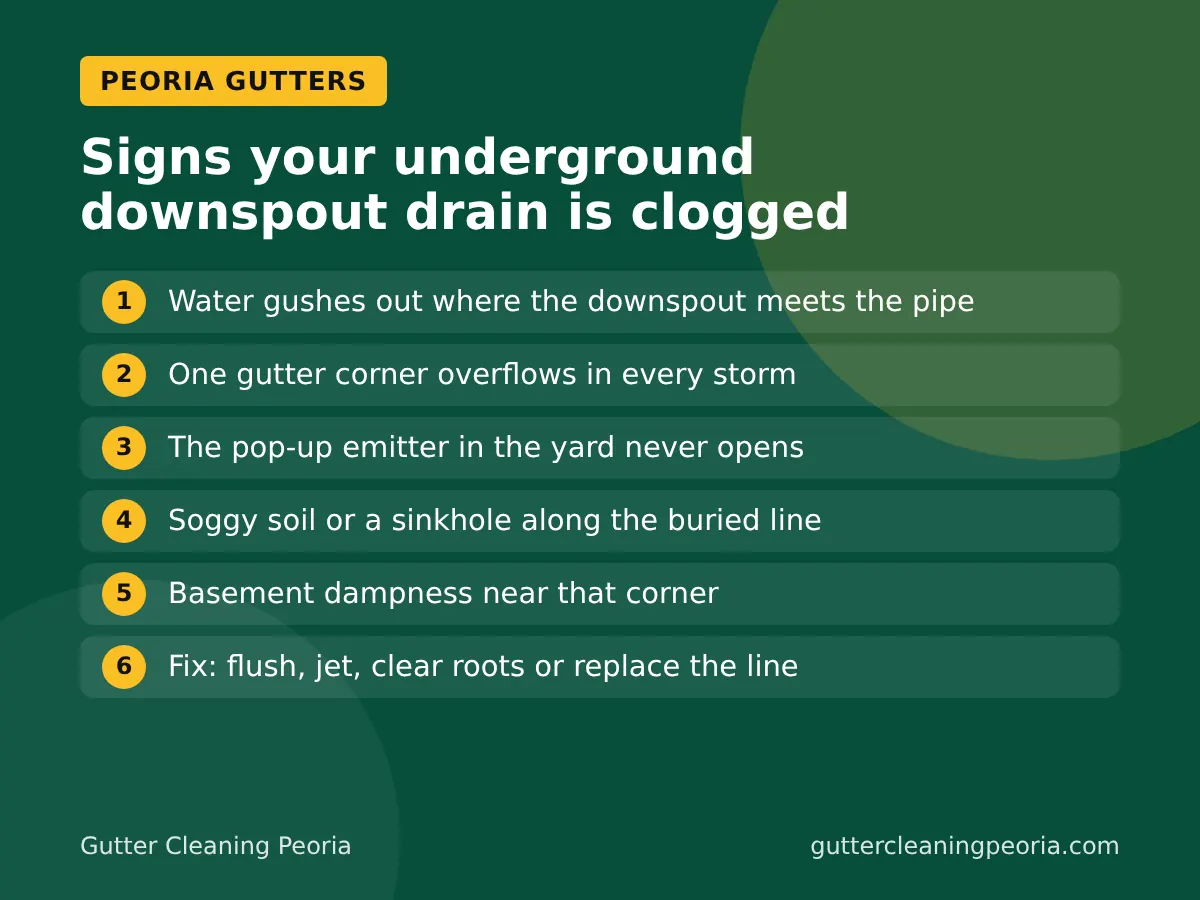
The clearest sign is water spilling out at the joint where the downspout meets the buried pipe during a storm. Other signs are a gutter corner that overflows even after the gutters are cleaned, a pop-up emitter that stays closed, wet or sinking soil along the pipe’s path, and a damp basement wall near that downspout.
- Water gushing at the boot. The joint where the downspout enters the ground spills or sprays water in heavy rain.
- One corner always overflows. The gutters are clean, but water still pours over one corner because it can’t leave fast enough.
- The emitter never pops up. The round cap at the end of the line stays shut, even in a downpour.
- Soggy or sinking soil. A wet strip or a small sinkhole along the pipe usually means a break or a separated joint.
- Basement dampness. Water on the wall or floor near that corner after rain.
- Gurgling or standing water in the downspout. You can hear or see water sitting in the bottom of the downspout after the rain stops.
Is the clog in the downspout or the buried pipe?
Check the downspout first. Pull the downspout off the drain boot or the adapter at the ground, then run a hose down from the top. If water comes out the bottom freely, the downspout is clear and the problem is in the buried pipe. If water backs up inside the downspout, the clog is in the downspout or an elbow.
Our guide to a clogged downspout walks through clearing the above-ground part. Once that is clear, put the hose straight into the buried pipe and let it run for a few minutes. If water backs up out of the opening, or the emitter never opens, the buried pipe is blocked.
What clogs an underground downspout drain?
Most clogs start in the gutters. Leaves, maple seeds, pine needles and shingle grit wash down the downspout and settle in the low spots of the buried pipe. Over time they pack into a plug. Roots, crushed pipe and frozen water cause the rest.
| Cause | What you’ll notice | Typical fix |
|---|---|---|
| Packed leaves and seeds | Slow drain that got worse over several seasons | Flush or snake the pipe |
| Shingle grit and sand | Heavy sludge at the boot or emitter | Flush, then jet if needed |
| Tree roots | Clog that keeps coming back near trees | Cut roots, replace joints or pipe |
| Crushed or sagging pipe | Sinkhole or wet strip in the lawn | Dig up and replace the section |
| Ice in winter | Backup only during freezing weather | Wait for thaw, check for damage |
| Animal nest or debris at the outlet | Emitter or outlet blocked from the outside | Clear and screen the outlet |
Peoria’s big oaks, maples and sweetgums drop a lot of debris in the fall, and many older homes use thin corrugated pipe that crushes easily under a mower or a car tire.
How do you clear an underground downspout drain?
Start with the easiest step and work up. Most clogs clear with a hose or a snake. If they don’t, the pipe may be broken and needs a camera or digging to find the problem.
- Clean the gutters and downspout. Otherwise the next storm washes more debris in.
- Open the outlet. Pull the pop-up emitter cap and clear any mud or debris at the end of the line.
- Flush from the low end. Feed a garden hose into the emitter end and push it up the pipe. Flushing uphill pushes the clog back the way it came.
- Try a drain snake. A hand auger or a bladder nozzle that expands in the pipe can break up packed debris.
- Jet or camera the line. If it still won’t drain, a pro can jet the line and run a camera to find a break or root intrusion.
- Replace damaged sections. Crushed corrugated pipe is usually replaced with smooth-wall PVC, which clogs less and is easier to clean.
Be careful near utility lines. Call JULIE (811 in Illinois) before you dig, even for a short trench.
Why does a clogged buried drain matter for your foundation?
A blocked drain sends roof water back to the base of the house. A single downspout can carry hundreds of gallons in a heavy Peoria storm. When it can’t drain, water spills at the boot and soaks the soil right next to the foundation. That leads to basement seepage, soil washing away and settling under walks and patios.
If you already see water collecting at the base of the house, our post on downspout water pooling at the foundation explains short-term fixes. Our guide to soil erosion and foundation damage covers the longer-term risks.
What should you do in winter?
Buried drains can freeze in a Central Illinois winter, especially if they hold water from a partial clog. Water then backs up at the boot and can freeze into a block of ice at the base of the downspout. In winter, many homeowners switch to an above-ground extension until spring.
- Clear the line in late fall, after the leaves are down.
- Use a seasonal adapter that lets you switch the downspout to an extension in winter.
- Keep the gutters clean so ice and debris don’t build up together.
Ice in the gutters can cause its own trouble. Our guide to winter gutter care and ice dams covers how to prevent it.
Should you repair, replace or disconnect the drain?
Clear it if a hose or snake gets water flowing again and the pipe is in good shape. Replace it if it is crushed, full of roots or keeps clogging. Disconnect it and use a long above-ground extension if you can’t fix it right away, as long as the water goes at least 4 to 6 feet from the house and away from your neighbor’s yard.
When a buried drain needs to be rerouted or a damaged downspout needs to be replaced, our team handles downspout repair in Peoria, from new downspouts and elbows to extensions and underground drain connections. We serve Peoria, Peoria Heights, East Peoria, Bartonville, Bellevue, Dunlap and Pekin.
How can you keep it from clogging again?
- Clean the gutters every spring and fall, and after big storms.
- Put a leaf strainer or screen at the top of each downspout.
- Flush each buried drain with a hose once a year.
- Use smooth-wall PVC, not corrugated pipe, when you replace a line.
- Add a cleanout at the base of the downspout so you can reach the pipe easily.
- Keep the emitter clear of mulch, grass and soil.
Frequently asked questions
How do I know if my underground downspout drain is clogged?
Common signs are water spilling out where the downspout meets the buried pipe, a gutter corner that overflows in every storm, a pop-up emitter that never opens, soggy soil or a sinkhole along the pipe’s path, and dampness in the basement near that corner. A hose test confirms it: run water into the drain and see if it backs up.
How do you unclog an underground downspout drain?
First clear the gutter and downspout so new debris doesn’t wash in. Then flush the buried pipe with a garden hose from the low end, or feed a drain snake or a hose nozzle made for clearing pipes up the line. Packed debris, roots or a crushed pipe may need a jetter, a camera or a dig and replace.
Why do underground downspout drains clog?
Leaves, shingle grit, pine needles and seed pods wash down from the gutters and settle in the low spots of the pipe. Roots can grow into joints, and cheap corrugated pipe can sag or get crushed. In Peoria’s freeze and thaw cycles, ice can also block the pipe and push joints apart.
Should I disconnect my downspout from the underground drain?
If the buried pipe is badly clogged or broken, disconnecting it and adding an above-ground extension that carries water at least 4 to 6 feet from the house is a good short-term fix. Don’t leave the open pipe uncapped, and don’t let water dump right next to the foundation.
How often should underground downspout drains be cleaned?
Flush them with a hose once a year, ideally after the fall leaf drop. Keeping the gutters clean in spring and fall and adding a leaf screen at the top of the downspout keeps most debris out of the buried line.
Water backing up at the downspout or a soggy strip of lawn along the drain line? Call Gutter Cleaning Peoria at (309) 321-9089. We clean gutters and downspouts, clear buried drains and repair or replace downspouts across Peoria and nearby towns.