
By the Gutter Cleaning Peoria team · Updated November 15, 2026
Short answer: Downspouts should send rainwater at least 4 to 6 feet away from your foundation, and farther on clay soil or where the yard slopes toward the house. If water pools by the foundation, add or lengthen the extension, turn the splash block away from the house, clear any clog and fix low spots in the soil. If the downspout is loose, crushed or leaking at the joints, it needs repair. Call (309) 321-9089.
After a hard rain, walk around your house. If you see puddles at the corners, muddy mulch washed out of the beds, or a wet stripe down the basement wall, your downspouts are dumping water where it does the most damage. Peoria’s clay soil holds water against the foundation, and freeze-thaw cycles from December through March push on basement walls and crack concrete. Here is how to fix the drainage, from five-minute fixes to when you need downspout repair in Peoria.
Why does water pool where downspouts drain?
Water pools when it leaves the downspout too close to the house or lands on ground that slopes back toward the foundation. The usual causes are a missing or short extension, a splash block turned the wrong way, soil that settled next to the house, or a downspout that is clogged, cracked or pulled loose so water spills at the wrong spot.
| What you see | Likely cause | First fix |
|---|---|---|
| Puddle right at the downspout | No extension or a short one | Add a 4 to 10 foot extension |
| Water flows back toward the wall | Soil slopes toward the house | Build up the grade away from the house |
| Water spills from the downspout joints | Clog or loose seams | Clear the clog, reseal or replace sections |
| Gutter overflows above the downspout | Clogged outlet or undersized downspout | Clean the outlet; consider a larger downspout |
| Wet basement wall at one corner | That downspout drains too close | Extend it and check the grade |
| Bubbling at a buried drain outlet | Underground pipe clogged or crushed | Flush or replace the line |
How far should a downspout drain from the house?
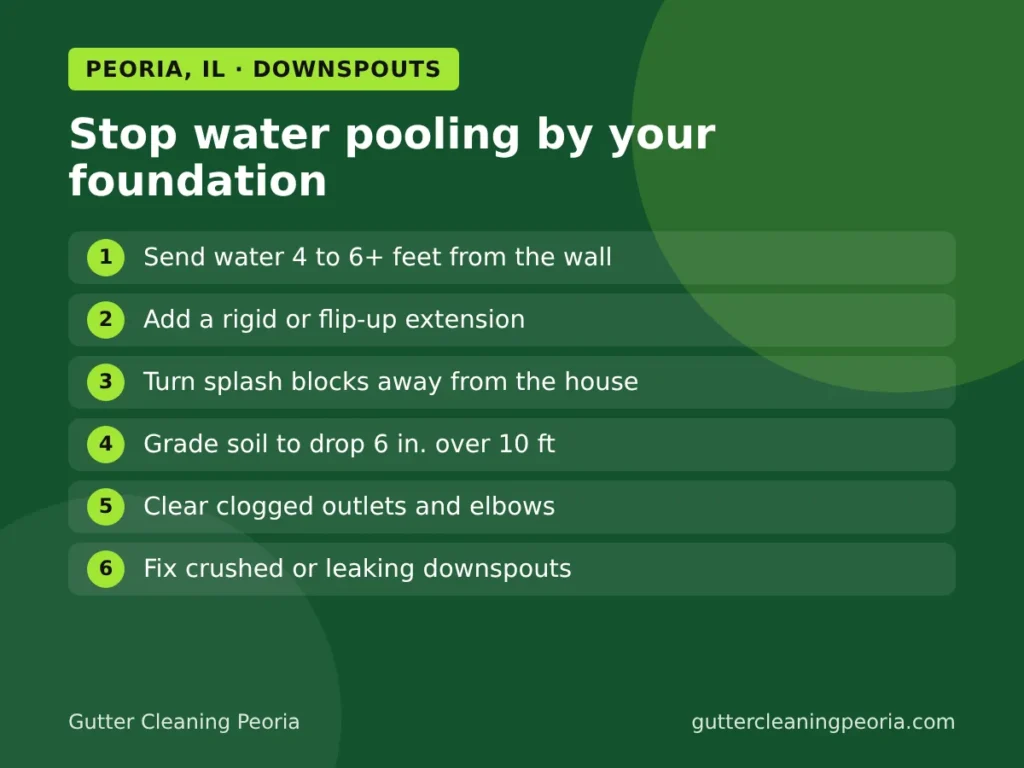
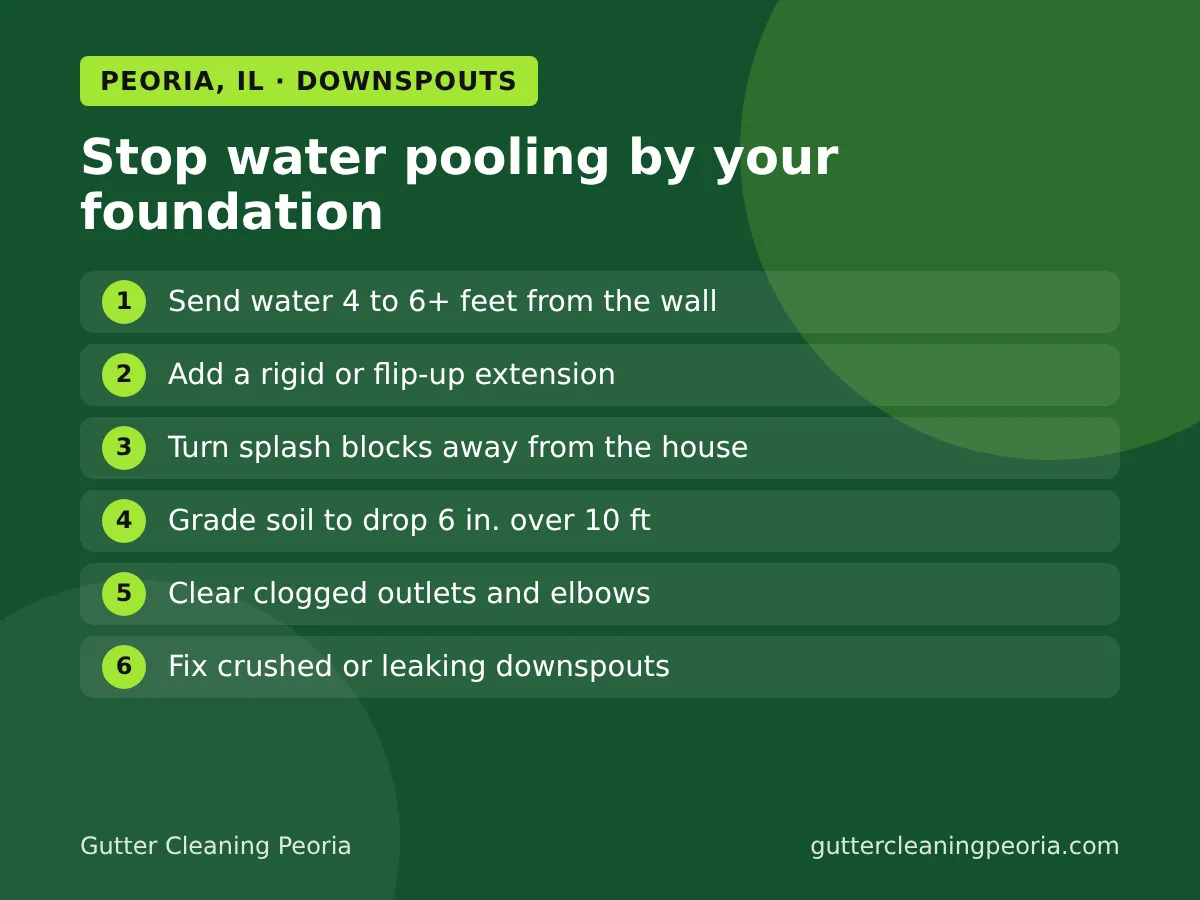
Send water at least 4 to 6 feet from the foundation. Ten feet is better on Peoria’s clay, on lots where the yard slopes toward the house, and for downspouts that drain a large section of roof. Water should land on ground that slopes away from the home and keep moving toward the yard, a swale or the street, not into a neighbor’s yard.
Homes on the bluffs and hillsides of the West Bluff, Peoria Heights and East Peoria need extra care. Water moves fast down a slope, so an extension that empties onto a steep bank can wash out soil. Aim it toward a gentler spot or use a buried line that ends at a pop-up emitter.
Which downspout extension works best?
The right choice depends on your yard, how often you mow and how much water each downspout carries. Rigid aluminum or vinyl extensions move the most water. Flip-up hinged extensions swing out of the way for mowing. Roll-out sleeves work for light flow. Buried drains hide the pipe completely but need a slope and an outlet.
- Splash block. Good for small roof areas on ground that already slopes away. Turn the open end away from the house.
- Rigid extension. The simplest real fix. Use one that reaches at least 4 to 6 feet.
- Hinged or flip-up extension. Lifts up for mowing. Make sure someone puts it back down before the next rain.
- Buried drain to a pop-up emitter. Clean look and no tripping hazard. Needs a steady slope and a debris filter at the top.
- Rain barrel with overflow. Catches some water for the garden, but the overflow still needs an extension.
What about the soil around the foundation?
Even a long extension cannot fix soil that slopes toward the house. Over time, backfill around a foundation settles and creates a trough that holds water. Build the soil up so it drops about 6 inches over the first 10 feet from the wall. Use soil with some clay, not just mulch or sand, which let water soak straight down.
Keep mulch a few inches below the siding, and do not let flower bed edging trap water against the house. In spring, check again, because freeze-thaw cycles can shift the ground.
When is the downspout itself the problem?
If water spills from the seams, the downspout is crushed by a mower or ladder, the straps have pulled loose, or the elbow at the bottom is cracked, the downspout needs repair or replacement. A downspout that is too small for the roof area can also back up during heavy storms and make the gutter overflow above it.
Clogs are common after fall in older Peoria neighborhoods with big oaks and maples. If water pours over the gutter right above the downspout, the outlet or an elbow is likely plugged with leaves and seeds. Clearing the gutters and downspouts before the first hard freeze keeps water moving all winter.
Do buried downspout drains work in Peoria?
They work well when they are installed right. The pipe needs a steady downward slope, smooth-wall pipe rather than thin corrugated tubing, and an outlet away from the house where the water can drain out. Without those, leaves and grit collect underground, water backs up at the downspout, and standing water can freeze and split the pipe in January.
The same rule applies in very different climates. Desert towns get short, hard monsoon storms, and homeowners there often have a Kingman AZ plumber check yard drains and the main line after a big storm. In central Illinois, the fix is usually simpler: keep the gutters clean, keep the pipe sloped and check the outlet each spring and fall.
When should you call a pro?
Call when downspouts are loose, crushed or leaking, when gutters overflow even after cleaning, when a buried drain backs up, or when one corner of the basement keeps getting wet after you added an extension. A pro checks the gutter pitch, downspout size and placement, and where the water ends up, then fixes the part that is actually failing.
We serve Peoria, East Peoria, Peoria Heights, Pekin, Bartonville, Bellevue and Dunlap. Ask about a gutter cleaning and drainage check together before winter.
Frequently asked questions
How far should a downspout drain from the house?
Most builders and home inspectors recommend sending water at least 4 to 6 feet from the foundation, and 10 feet is better on clay soil or where the yard slopes toward the house. In Peoria’s heavy clay, water soaks in slowly, so more distance helps.
Why is water pooling at the bottom of my downspout?
The water has nowhere to go. The extension may be missing, too short or crushed, the splash block may tilt toward the house, or the ground around the foundation may have settled. A clogged or disconnected downspout can also spill water at the wrong spot.
Are buried downspout drains a good idea in Peoria?
They work well when they are sloped, sized right and end at a pop-up emitter or daylight outlet. The risk is that leaves and grit clog them underground, and standing water can freeze in winter. Keep the gutters clean and add a debris filter where the downspout enters the pipe.
Can gutters cause basement water problems?
Yes. Overflowing gutters and downspouts that empty next to the house are some of the most common reasons for damp basements and wet crawl spaces in central Illinois. Fixing the drainage is usually the first and cheapest step.
Should I disconnect my downspouts from the sewer?
Many older Peoria homes have downspouts tied into underground pipes. Check with the City of Peoria about local rules before changing them, and have the pipes checked if water backs up at the connection.
Water still pooling after a rain? Call Gutter Cleaning Peoria at (309) 321-9089. We will check your gutters, downspouts and drainage and give you a clear quote before any work starts.