
If you’ve noticed bare patches of dirt hugging your home’s perimeter, small gullies forming after a storm, or mulch that keeps washing into your driveway, your gutters are probably part of the problem. Regular gutter cleaning in Peoria is one of the cheapest ways to stop soil erosion before it turns into a foundation repair bill. When water dumps straight off the roofline instead of being channeled away, it doesn’t just erode topsoil — it undermines the ground your house sits on.
Table of Contents
Quick Answer: Do Clogged Gutters Cause Foundation Erosion?
Yes. A clogged or misaligned gutter system forces rainwater to overflow directly next to your home instead of routing it several feet away. Over time, that concentrated water flow strips away topsoil, carves channels next to the foundation, and saturates the soil beneath footings. In Peoria’s silty clay soil, that saturation — combined with the freeze-thaw cycles our winters bring — is what eventually leads to foundation cracks, uneven settling, and basement or crawlspace moisture problems.
Why Peoria’s Soil and Climate Make This Worse
Much of Peoria sits on silty clay loam, including the Ipava series that’s common throughout the area. This soil type holds water rather than draining it away, and it expands when saturated and contracts as it dries. Add Peoria’s freeze-thaw winters into the mix, and the ground around your foundation is working against you twice a year: swelling during wet spring snowmelt, then heaving and cracking during winter freezes.
Peoria gets around 38 inches of rain annually, with spring being the wettest stretch of the year. That’s also when snowmelt saturates the ground before the heaviest rains even arrive, leaving soil with little capacity left to absorb runoff. A gutter system that’s clogged with fall leaf debris going into that wet spring stretch is set up to overflow at the worst possible time.
How Gutters Actually Prevent Erosion and Foundation Damage
A properly functioning gutter system does two jobs at once: it captures the water coming off your roof, and it delivers that water to a discharge point far enough from the house that it can’t undermine the soil. When either part of that system fails, erosion follows almost immediately.
- Overflowing gutters create a “waterfall” effect along the roofline, hammering the same strip of soil every time it rains.
- Detached or sagging sections dump water in one concentrated spot instead of spreading it along the gutter run.
- Missing or short downspouts release water within a foot or two of the foundation, close enough to seep straight into the footing zone.
- Clogged downspouts back water up into the gutter, forcing it over the front lip and straight down next to the siding.
Routine gutter cleaning in Peoria — clearing debris, resealing loose joints, and confirming downspouts are extended properly — interrupts all four of these failure points before they become a drainage disaster.
Warning Signs You Already Have a Gutter-Erosion Problem
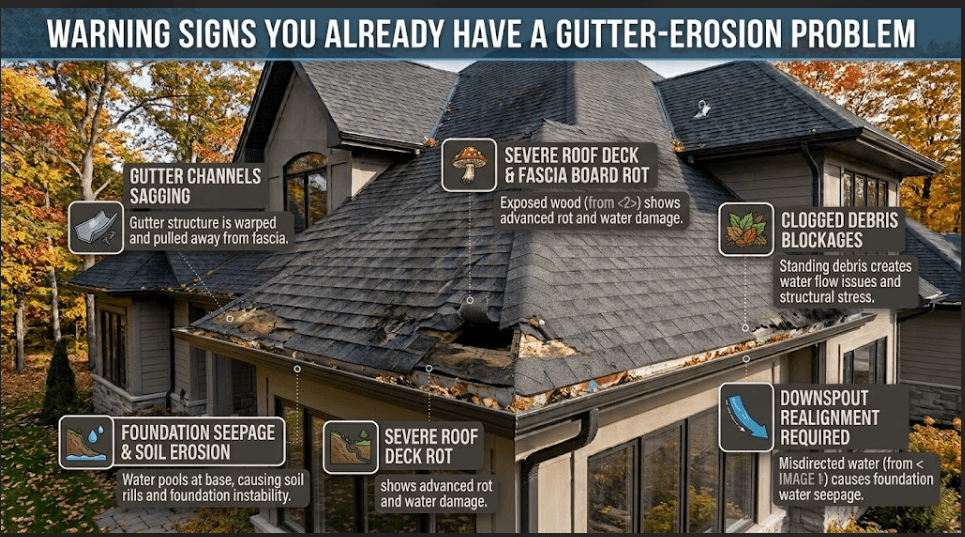
Walk your foundation line after the next rain or spring thaw and look for these signs:
- Visible soil channels or small ravines running from the roofline toward the yard
- Mulch or landscaping rock pushed away from the house in a fan pattern
- Standing water pooling within a few feet of the foundation hours after rain or snowmelt stops
- Exposed roots or a noticeable dip in the grade next to the house
- Fascia board rot or dark staining on the trim just below the gutter line
- Hairline cracks in the foundation, or a door/window that has started sticking
Any one of these on its own might be minor. Two or more together usually means water has been mismanaged near your foundation for a while — and Peoria’s clay-rich soil rarely forgives that for long.
Downspout Placement: The Fix Most Homeowners Skip
Even homeowners who clean their gutters regularly often overlook downspout placement, and it’s arguably the most important erosion-prevention detail. Downspouts should discharge water at least 6 to 10 feet from the foundation, not directly onto a splash block sitting a few inches from the siding. In Peoria’s silty clay loam, that extra distance is what keeps runoff from pooling against the footing instead of draining past it.
A downspout realignment — repositioning the discharge point, adding an extension, or tying into an underground drain line that daylights well away from the house — is a low-cost fix that solves a surprising number of erosion complaints. If your yard slopes back toward the house instead of away from it, an extension alone may not be enough, and grading work should be paired with the gutter fix.
Seamless Gutters vs. Sectional: Does It Matter for Erosion?
Seamless gutters are formed in one continuous piece and have far fewer joints than sectional gutters, which means fewer places for leaks to develop over time. Sectional systems rely on seams every few feet, and each seam is a potential failure point where water can escape mid-run instead of reaching the downspout. For erosion control specifically, fewer leak points means water stays contained and gets delivered to the discharge point as designed, rather than dribbling out along the gutter run and eroding the bed below it.
DIY Maintenance vs. Calling a Professional
Basic debris removal twice a year is something most homeowners can handle safely from a stable ladder. But a few situations call for a professional inspection rather than a DIY fix:
- The gutter has visibly pulled away from the fascia board
- You’re seeing water damage or rot on the trim, soffit, or siding
- Erosion channels have already formed and deepened after multiple storms or a spring thaw
- Downspouts run underground and you’re not sure where they discharge
- The home has two or more stories, making ladder access unsafe
For anything beyond a simple cleaning, working with a team that offers professional gutter installation in Peoria ensures the pitch, downspout count, and discharge points are actually sized for the volume of water your roof sheds — not just patched with a generic fix.
What Professional Gutter Service Typically Includes
A thorough visit usually covers debris removal from gutters and downspouts, a check for loose hangers or separated seams, resealing of end caps and joints, a flow test to confirm water reaches the downspout without backing up, and an assessment of where each downspout discharges relative to the foundation. Homeowners dealing with recurring erosion often benefit from a full evaluation of downspout extension and drainage needs together, since cleaning alone won’t fix a discharge point that’s too close to the house.
Seasonal Maintenance Timeline for Peoria Homes
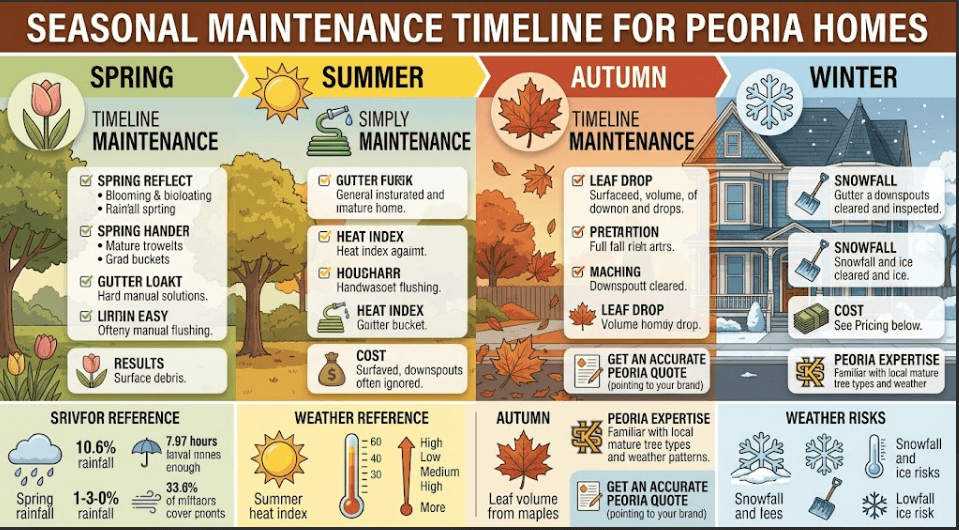
| Season | What to Check |
|---|---|
| Late winter | Clear leftover debris before spring snowmelt and rain begin |
| Spring | Inspect downspout extensions and grading after freeze-thaw movement |
| Summer | Check for overflow during Peoria’s heavier thunderstorm stretches |
| Fall | Full cleaning before leaves accumulate ahead of winter freeze |
Staying ahead of each season keeps the system working when it matters most — during the spring snowmelt and rain combination that causes the fastest erosion around Peoria foundations.
For homeowners who’d rather not troubleshoot this alone, our team provides gutter repair services in Peoria and the surrounding community, from debris removal to full downspout re-routing.
Frequently Asked Questions
How long does it take for gutter overflow to cause foundation erosion?
It can happen faster than most homeowners expect. In Peoria’s silty clay soil, a single wet spring — especially with leftover snowmelt saturating the ground — is often enough to carve a visible channel next to an unmaintained foundation.
Can soil erosion from gutters actually crack a foundation?
Yes. When erosion removes supporting soil from under or beside a footing, the foundation loses even support and can settle unevenly, which is what produces cracks, sticking doors, and sloped floors over time.
How often should gutters be cleaned in Peoria?
Most homes need cleaning at least twice a year — once in late fall after leaf drop and once in early spring before the wettest stretch of the year arrives. Homes with heavy tree coverage may need a mid-season check as well.
Do I need French drains in addition to gutter fixes?
Not always. If downspouts are properly extended and the yard grade already slopes away from the house, gutters alone often solve the problem. French drains become necessary when the yard itself holds water regardless of roof drainage, or when the soil is already saturated from years of poor runoff management.
What’s the difference between gutter cleaning and gutter maintenance?
Cleaning removes debris. Maintenance includes cleaning plus checking hangers, seams, pitch, and downspout function — the parts of the system that actually prevent erosion, not just clogging.
Are seamless gutters worth the extra cost for erosion prevention?
For most homes, yes. Fewer joints mean fewer mid-run leaks, which keeps water contained until it reaches the downspout instead of dribbling out along the gutter and eroding the bed below.
How far should downspouts discharge from the foundation?
At least 6 feet, with 10 feet or more recommended in clay-heavy soil like Peoria’s, since silty clay loam holds moisture longer than sandy or well-drained soil.
Does winter freeze-thaw make erosion worse in Peoria?
Yes. Freezing and thawing cycles shift and loosen soil that’s already saturated from poor drainage, which is why erosion channels often widen noticeably by the time spring arrives.
Can I fix gutter-related erosion myself?
Minor cases — adding a downspout extension or clearing a clog — are DIY-friendly. Established erosion channels, sagging gutter runs, or signs of foundation movement should be evaluated by a professional before the damage spreads.
The City of Peoria’s stormwater program has additional detail on how erosion and runoff are managed citywide, along with permitting requirements for larger drainage projects. City of Peoria Stormwater Overview
Serving the greater Peoria community with gutter cleaning, repair, and installation. Get in touch with our team to schedule an inspection before the next storm rolls through.