
Every fall, thousands of Peoria homeowners ask the same question: is paying for gutter cleaning actually worth it, or is it just another maintenance bill? The short answer is that skipping gutter cleaning in Peoria almost always costs more than the service itself. This guide breaks down the real numbers — what cleaning costs, what neglect costs, and how to decide what makes sense for your home.
Table of Contents
Quick Answer: Is Gutter Cleaning Worth It in Peoria?
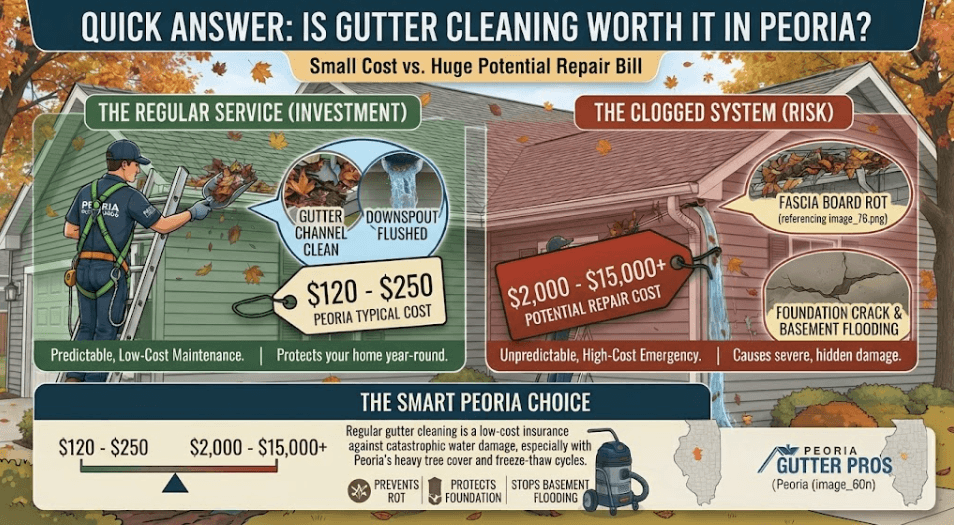
Yes. Gutter cleaning in Peoria typically costs between $120 and $250 per visit, while the water damage caused by a single clogged, overflowing gutter system can run from $2,000 for minor fascia board rot to $15,000+ for foundation repair and basement flooding. When you compare a predictable, low-cost service against an unpredictable, high-cost repair bill, the math favors regular cleaning almost every time — especially in a region with Peoria’s tree cover and freeze-thaw winters.
The Real Cost of Gutter Cleaning in Peoria: What You’re Actually Paying For
A standard gutter cleaning appointment isn’t just someone scooping leaves out of a trough. A thorough job includes:
- Removing debris from gutters and downspouts
- Flushing downspouts to clear hidden clogs
- Checking for sagging sections, loose hangers, and pitch problems
- Inspecting seams and end caps for leaks
- Downspout realignment where water is draining toward the foundation instead of away from it
- A visual check of the fascia board for early rot or water staining
Most single-story homes run on the lower end of that price range, while two-story homes with steep pitches or heavy tree coverage cost more due to added labor and equipment. Homes with leaf guards or gutter screens sometimes cost less to maintain per visit but still need periodic inspection, since screens can trap fine debris over time.
What Happens When You Skip Gutter Cleaning
Clogged gutters don’t fail quietly. Water has to go somewhere, and in most cases it ends up in one of these places:
- Fascia and soffit rot — Standing water in a clogged gutter sits against the fascia board for weeks, softening the wood until it rots and needs replacement.
- Foundation cracking — Overflowing water pools at the base of the house instead of draining through the downspout, saturating soil and putting pressure on foundation walls.
- Basement and crawlspace moisture — Once water gets past the foundation, it often shows up as basement seepage, musty odors, or mold growth.
- Ice dams in winter — Clogged gutters hold water that refreezes overnight, forcing melt water back under the roofline instead of off the roof.
- Pest infestations — Standing organic debris in a gutter is an ideal breeding ground for mosquitoes and a nesting spot for rodents and insects.
The Federal Emergency Management Agency lists gutter maintenance as a basic step in preparing a home against storm-related water damage, since clogged systems can no longer move water away from the structure the way they’re designed to. You can review their seasonal home preparedness guidance for more on this.
Cost-Benefit Breakdown: Cleaning vs. Repair vs. Replacement
| Scenario | Typical Cost | Frequency |
|---|---|---|
| Routine gutter cleaning | $120 – $250 | 2x per year |
| Downspout realignment / minor repair | $150 – $400 | As needed |
| Fascia board repair (rot from overflow) | $500 – $2,000 | One-time, after damage |
| Foundation crack repair | $2,500 – $8,000 | One-time, after damage |
| Basement waterproofing after flooding | $5,000 – $15,000+ | One-time, after damage |
| Full gutter replacement (neglect-driven) | $1,500 – $5,000 | Every 15–20 years, sooner if neglected |
Two cleanings a year for a typical Peoria home lands somewhere around $250–$500 annually. Compare that to even the smallest repair category — fascia rot — and you’re looking at a bill that can wipe out four to eight years of cleaning costs in a single incident. That’s the core of the cost-benefit case: cleaning is a fixed, small, predictable expense; neglect is a variable, large, unpredictable one.
Peoria’s Climate Makes Gutter Maintenance Non-Negotiable
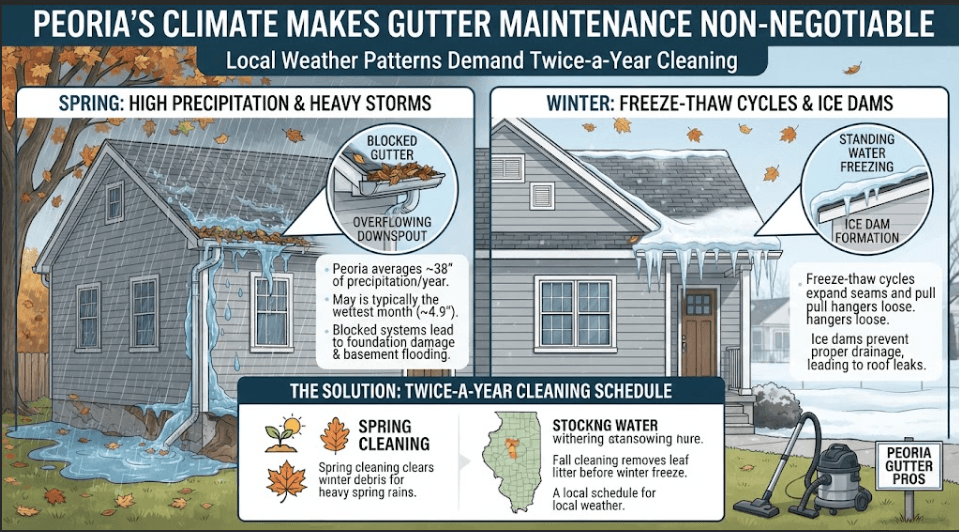
Local weather is the piece a lot of generic maintenance articles skip. Peoria averages roughly 38 inches of precipitation a year according to the Illinois State Climatologist’s official NOAA normals, with May typically the wettest month at close to 4.9 inches. That volume of water needs somewhere to go, and a blocked gutter system simply can’t move it fast enough during a heavy spring storm.
Winter adds a second layer of risk. Peoria’s freeze-thaw cycles mean standing water in a clogged gutter can freeze overnight, thaw during the day, and refreeze again — a pattern that expands gutter seams, pulls hangers loose, and sets up ice dams along the roofline. The National Weather Service’s Peoria climate data shows this swing between wet spring months and freezing winter temperatures is a consistent yearly pattern, not a one-off event, which is exactly why a twice-a-year cleaning schedule (spring and fall) lines up with the local weather calendar rather than an arbitrary maintenance rule.
Signs You Need Gutter Cleaning Now
- Visible plant growth or moss sprouting from the gutter line
- Water spilling over the sides during rain instead of channeling to the downspout
- Sagging or pulling-away sections along the roofline
- Staining or streaking on the siding below the gutter
- Puddles forming near the foundation after rainfall
- Pest activity — birds, mosquitoes, or rodents — around the gutter line
If you’re seeing two or more of these signs, the gutters have likely been clogged for a while, and a same-week appointment is worth prioritizing over waiting for the next scheduled visit.
DIY vs. Professional Gutter Cleaning in Peoria
DIY cleaning is possible for single-story homes with stable ladder access, but it comes with real trade-offs:
- Fall risk — Ladder falls are one of the most common causes of home-maintenance injuries, and gutter cleaning is a repeat offender because of unstable footing on wet debris.
- Missed problems — A homeowner clearing leaves by hand often misses downspout clogs, loose hangers, or early fascia rot that a trained eye catches during inspection.
- Time cost — A full cleaning and inspection takes longer than most people expect once you factor in ladder setup, debris bagging, and downspout flushing.
Professional service closes those gaps: proper equipment for two-story homes, a systematic inspection alongside the cleaning, and the ability to catch a small problem — like a single loose hanger — before it turns into a sagging, leaking section.
Final Verdict
When you weigh a $120–$250 twice-yearly service against repair bills that start in the thousands, gutter cleaning in Peoria isn’t a discretionary expense — it’s cheaper insurance against foundation, fascia, and basement damage. The homeowners who skip it aren’t saving money; they’re deferring a much larger bill and hoping the next storm season is mild.
If it’s been more than six months since your last cleaning, or you’ve noticed any of the warning signs above, professional gutter cleaning services in Peoria can get ahead of the problem before the next heavy rain does the damage for you. You can also reach out directly at guttercleaningpeoria.com to get a straightforward quote based on your home’s size and roofline.
Frequently Asked Questions
How often should gutters be cleaned in Peoria?
Twice a year is the standard recommendation — once in late spring after seed pods and helicopter seeds drop, and once in late fall after leaves have fallen. Homes surrounded by mature trees may need a third check mid-summer.
How much does gutter cleaning cost in Peoria?
Most single-story homes fall between $120 and $250 per visit. Two-story homes, steep rooflines, or heavy debris loads can push the price higher due to added labor and safety equipment.
Can clogged gutters really damage my foundation?
Yes. When gutters overflow instead of channeling water to the downspout, it pools at the base of the house. Saturated soil expands and contracts, which puts pressure on foundation walls and can lead to cracking over time.
Is it cheaper to install leaf guards instead of cleaning regularly?
Leaf guards reduce how often you need a full cleaning but don’t eliminate the need entirely. Fine debris like pine needles and shingle grit still gets through most guard systems, so periodic inspection is still worthwhile.
What’s the difference between gutter cleaning and gutter repair?
Cleaning removes debris and flushes downspouts to restore proper water flow. Repair addresses physical damage — sagging sections, separated seams, loose hangers, or holes — that cleaning alone won’t fix.
Do I need gutter cleaning if I don’t have many trees near my house?
Yes, though less often. Roof grit, airborne debris, and nesting material build up even without heavy tree cover, and Peoria’s rainfall volume means any blockage — large or small — creates overflow risk.
How do I know if my downspouts are actually clogged?.
Run a hose into the gutter near the downspout opening. If water backs up instead of flowing through and out the bottom, the downspout has a blockage that needs to be cleared.
Does hard water affect gutters the way it affects appliances?
Not directly, since gutters handle rainwater rather than tap water. However, mineral and sediment buildup from roof runoff can still contribute to slow drainage over time, similar to scale buildup in plumbing fixtures.
What time of year is riskiest for skipping gutter cleaning in Peoria?
Late fall through early spring. Leaves clog gutters heading into winter, and any blockage left in place through freeze-thaw cycles is more likely to cause ice dams, seam separation, or hanger failure before spring rains arrive.