
Gutters rarely fail all at once. They wear down slowly through freeze-thaw cycles, clogged downspouts, and sagging hangers until a single spring storm turns a small problem into a foundation repair bill. Setting aside a realistic annual budget for gutter maintenance in Central Illinois is the cheapest insurance a homeowner can buy against water damage, and it costs far less than most people assume once you know what to plan for.
Table of Contents
What Should You Budget for Gutter Maintenance in Central Illinois Each Year?
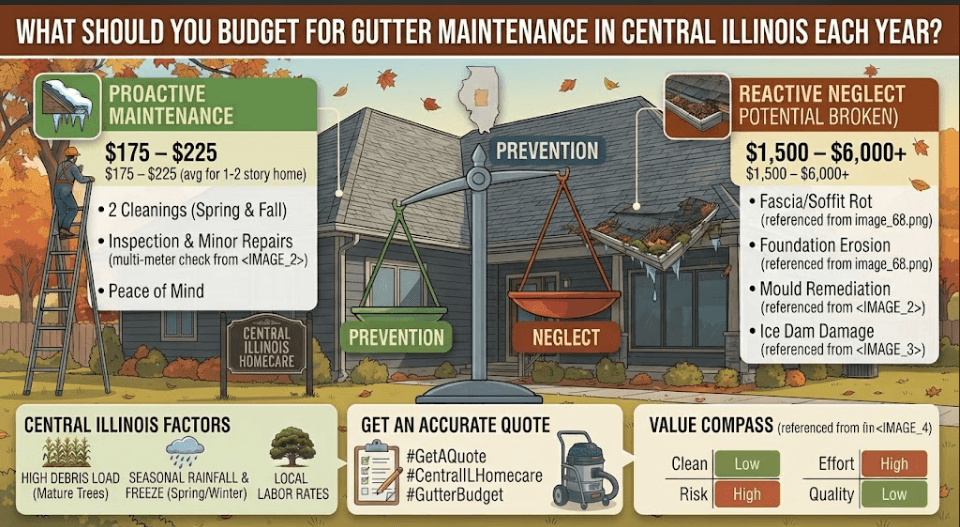
Quick answer: Most Central Illinois homeowners should budget $200–$450 per year for routine gutter maintenance, split between two seasonal cleanings ($99–$229 each depending on home size), plus a small reserve of $100–$300 for minor repairs like resealing seams, tightening hangers, or realigning a downspout. Homes with mature trees, steep rooflines, or gutter guards should budget toward the higher end.
That range covers upkeep only. It doesn’t include full gutter replacement, which is a separate, less frequent expense discussed further down.
Why Central Illinois Weather Drives This Budget
Peoria and the surrounding Central Illinois region get roughly 36 inches of rain a year, with April and May typically the wettest stretch. That volume of water has to go somewhere, and if your gutters are clogged when spring rains hit, it goes straight down your siding and against your foundation instead of through the downspouts. The City of Peoria’s own stormwater program explains how impervious surfaces like rooftops accelerate runoff volume and velocity when drainage systems aren’t functioning properly — which is exactly what a clogged residential gutter system does on a smaller scale.
Three seasonal factors shape a realistic budget here:
- Spring flooding season (March–May): Heavy rainfall exposes any debris left over from fall, causing overflow at the worst possible time.
- Fall leaf drop (October–November): Oak and maple leaves common throughout Peoria County clog downspouts within a matter of weeks.
- Winter freeze-thaw cycles (December–February): Trapped water in unclean gutters freezes, expands, and can pull fascia boards and hangers loose, leading to ice dams.
Budgeting around these three windows, rather than a single annual cleaning, is what actually protects a home in this climate.
Sample Annual Gutter Maintenance Budget
| Line Item | Frequency | Estimated Cost |
|---|---|---|
| Spring cleaning (post-flood season) | 1x/year | $99–$229 |
| Fall cleaning (post-leaf drop) | 1x/year | $99–$229 |
| Minor repairs (seams, hangers, realignment) | As needed | $100–$300 |
| Downspout flushing/inspection | Included with cleaning | $0 (bundled) |
| Gutter guard installation (optional, one-time) | Once, amortized over years | $600–$1,800 upfront |
| Total routine annual budget | — | $200–$450 |
Homes with 2–3 stories, over 200 linear feet of gutter, or steep rooflines should plan for the higher end of each range, since access and time on the roof both increase labor cost.
The Real Cost of Skipping the Budget
Foundation crack repair in the Peoria area commonly runs $3,000 to $15,000, compared to $99–$250 for a single professional cleaning. That gap is the entire argument for budgeting proactively rather than reactively. Beyond foundation damage, neglected gutters also contribute to:
- Basement seepage and mold growth from water pooling near the foundation
- Fascia board rot where water sits against wood trim
- Soffit and attic moisture intrusion during ice dam season
- Landscaping and mulch bed erosion from overflow
InterNACHI’s guidance for home inspectors notes that a properly sized, well-maintained gutter system is essential for channeling roof runoff away from a structure, since even a modest rainfall can produce thousands of gallons of water that must be redirected from the foundation. Skipping a year of maintenance to save $200 can easily turn into a five-figure repair.
How to Actually Stick to the Budget
- Schedule two cleanings a year in advance. Book spring and fall service before the rush — providers get backed up right after the first big storm or the first hard freeze warning.
- Set aside a small repair reserve. Even well-maintained gutters develop loose hangers or minor seam leaks over 5–7 years. A $100–$300 cushion covers this without surprise.
- Track linear footage and roof pitch. Pricing scales with these two factors more than anything else, so knowing your home’s numbers helps you get accurate quotes instead of guessing.
- Consider gutter guards if you have heavy tree cover. The upfront cost is higher, but it can reduce cleaning frequency and labor cost over several years — request pricing through our gutter guard installation service for an honest cost comparison based on your roofline.
- Reassess every 5–10 years for replacement. Aluminum gutters typically last 20+ years, but sagging, separated seams, or repeated leaks are signs it’s time to budget for gutter replacement instead of continued patch repairs.
When Maintenance Isn’t Enough
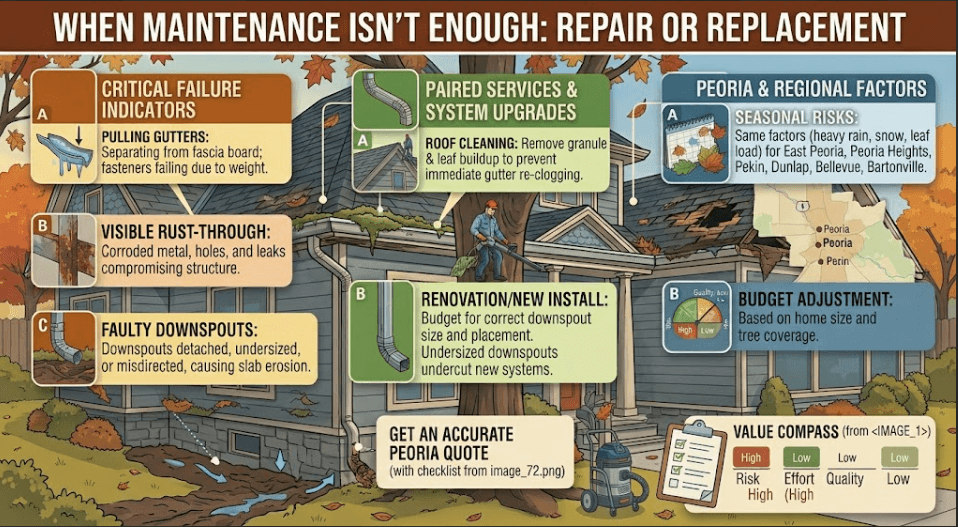
Routine cleaning and small repairs only go so far. If you’re noticing pulling gutters, visible rust-through, or downspouts that no longer direct water away from the slab, that’s a gutter repair or replacement conversation, not a cleaning one. Homes going through a full renovation or new gutter installation should also budget separately for downspout installation and repair, since a mismatched or undersized downspout can undercut an otherwise solid new system.
If your roof sheds a lot of granule or leaf buildup, pairing gutter service with periodic roof cleaning prevents debris from washing straight back into freshly cleaned gutters.
For a deeper breakdown of what drives pricing in this market, see our full gutter cleaning cost guide for Peoria, IL, and if you want to understand exactly what happens when maintenance gets skipped, read what happens to decomposing leaves left in gutters too long.
Homeowners in East Peoria, Peoria Heights, Pekin, Dunlap, Bellevue, and Bartonville face the same seasonal risk factors and should budget on the same schedule described above, adjusted only for home size and tree coverage.
FAQs About Budgeting for Gutter Maintenance in Central Illinois
How much should I budget per year for gutter maintenance in Peoria?
Plan for $200–$450 annually, covering two seasonal cleanings and a small repair reserve. Larger or multi-story homes trend toward the higher end.
How often should gutters be cleaned in Central Illinois?
Twice a year is the standard recommendation — once in spring before flood season and once in fall after leaves drop. Homes with heavy tree cover sometimes need a mid-season check as well.
Is it cheaper to install gutter guards or keep paying for cleanings?
Gutter guards cost more upfront ($600–$1,800 typically) but can reduce how often you need professional cleaning, especially on tree-heavy lots. Over 5–10 years, guards often pay for themselves in reduced labor costs.
What’s included in a typical professional gutter cleaning?
A full service includes debris removal, downspout flushing, a leak and clog inspection, debris bagging and disposal, and a final flow check to confirm water moves freely through the system.
How do I know if I need repair instead of just cleaning?
Sagging sections, visible separation at seams, water spilling over the sides during rain, or downspouts pulling away from the wall all point to a repair need rather than routine cleaning.
Does hard water or mineral buildup affect Central Illinois gutters?
Mineral deposits primarily affect appliances more than gutters, but sediment and grit from asphalt shingles can accumulate in gutter channels over time, which is why a flush-and-inspect step matters during every cleaning.
Should I budget separately for downspout repair?
Yes. Downspouts are often overlooked in a maintenance budget but are just as critical — a clogged or misaligned downspout can undo the benefit of a freshly cleaned gutter run.
When should I budget for full gutter replacement instead of repair?
If a system is 20+ years old, has repeated leaks across multiple sections, or shows separation at multiple seams, replacement is usually more cost-effective long-term than continued patch repairs.
Ready to put a maintenance schedule in place before the next storm rolls through? Get a free gutter cleaning estimate from our local Central Illinois team and start budgeting with real numbers instead of guesswork.