
By the Gutter Cleaning Peoria team · Updated November 11, 2026
Short answer: If water pours over one corner of your gutter during rain while little comes out the bottom of the downspout, the downspout is clogged. Most clogs sit at the gutter outlet or in the elbows. Clear the outlet, flush from the bottom with a hose, and use a plumber’s snake if needed. Minor downspout repairs here run about $150 to $300. Call (309) 321-9089 if you would rather not climb.
Fall in Peoria means oak and maple leaves, seed pods and shingle grit all heading for the same narrow opening. Once the downspout plugs, the whole gutter fills, overflows at the corner and dumps water right next to your foundation. This guide shows you where downspouts clog, how to clear them safely, what repair costs and when to call us for downspout installation and repair.
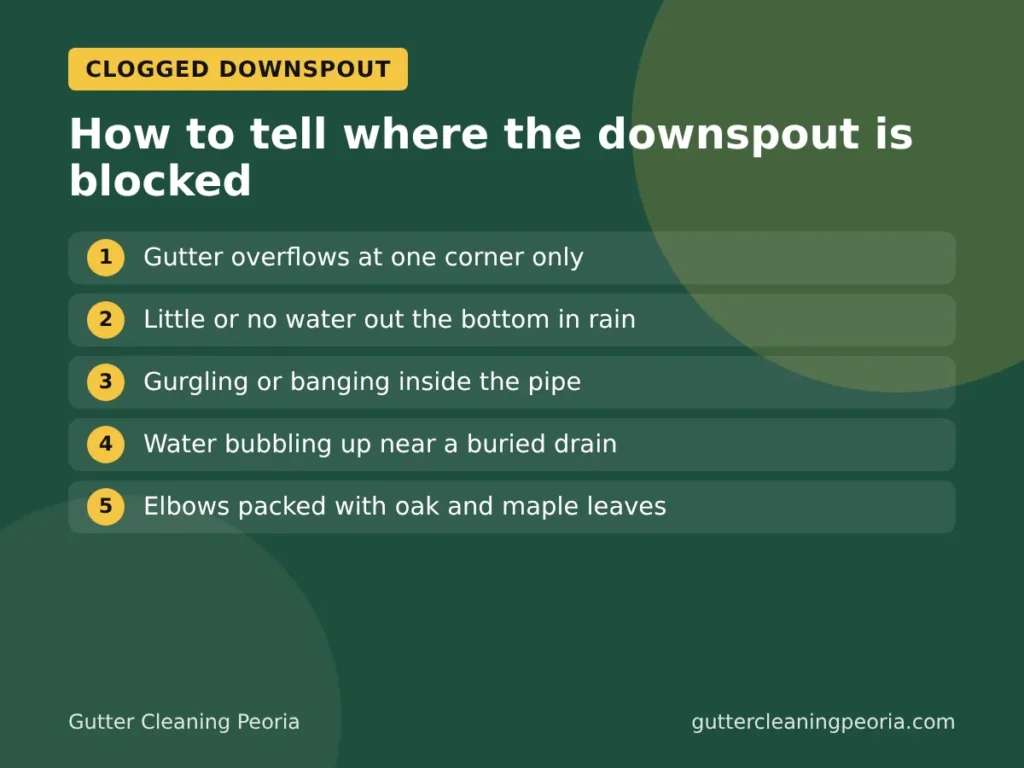
How can you tell a downspout is clogged?
Watch it during a steady rain. A working downspout sends a strong stream out the bottom within a minute or two. A clogged one dribbles or stays dry, while the gutter next to it fills and spills over the front edge. Gurgling sounds, a solid thud when you tap the pipe and a muddy, washed-out spot by the corner are other signs.
| What you see | Where the clog likely is | First step |
|---|---|---|
| Gutter overflows at the downspout corner only | Gutter outlet at the top | Clear the outlet by hand |
| Water backs up partway, pipe sounds full | Upper or lower elbow | Flush and snake from the top |
| Downspout drains, but water pools at the bottom | Splash block or extension | Move or reset the extension |
| Water bubbles up from the ground or the pop-up never opens | Underground drain pipe | Flush the buried line; call if it won’t clear |
| Downspout pulled away or crushed | Damaged pipe | Repair or replace the section |
Where do downspouts usually clog?
Most clogs start at the top, where leaves pile up over the outlet hole, or in the bends. A downspout usually has two elbows near the top to bring it back to the wall and one at the bottom. Wet leaves fold and jam at each turn. Underground drains are the third trouble spot, because anything that gets past the elbows settles in the buried pipe.
Corners where two roof planes meet carry the most water and the most debris. If one downspout always seems to clog first, it is probably under a valley. Our guide to roof valleys and gutters explains why.
How do you unclog a downspout safely?
Start from the ground and only climb if you have to. Most downspout clogs can be cleared with a garden hose and a plumber’s snake. If you do need a ladder, set it on firm, level ground, keep three points of contact and never lean it on the gutter itself. Review our tips on ladder safety when cleaning gutters first.
- Clear the bottom. Remove the extension or splash block and pull out any leaves you can reach at the lower elbow.
- Flush from the bottom. Push a garden hose up the downspout as far as it goes and turn it on full. Back-flushing often pops a clog loose from below.
- Clear the gutter outlet. From a ladder, scoop out the leaves around the outlet hole at the top. A packed outlet is the most common clog.
- Flush from the top. Run the hose into the outlet. If water backs up, the clog is in an elbow.
- Snake it. Feed a plumber’s snake down through the outlet and work it through the elbows until water runs freely.
- Take it apart if needed. Remove the screws at the lower elbow, pull it off, clear it and refit it with new screws.
- Test with water. Run the hose at the far end of the gutter and make sure a strong stream comes out the bottom.
Do not use a pressure washer inside aluminum downspouts. It can split seams and dent the pipe, which creates a new place for leaves to catch.
What about underground downspout drains?
Many Peoria homes run downspouts into buried pipe that carries water away from the house to a pop-up outlet in the yard. These lines clog with grit and leaves, sag in shifting clay soil and freeze in winter. If water bubbles up near the downspout or the pop-up never opens, the buried line is likely blocked.
Flush the line with a hose from the downspout end. If that fails, a drain snake or a jetter can clear it, but a crushed or root-filled pipe has to be dug up and replaced. Keeping the gutters above it clean is the best way to protect the buried pipe. Water that can’t drain away often ends up in the soil next to the house; see how gutters affect soil erosion and your foundation.
How much does downspout repair cost in Peoria?
Most downspout work in the Peoria area runs about $150 to $300 for minor repairs, such as clearing a stubborn clog, refastening straps or replacing an elbow. Partial replacement runs about $300 to $600, and a full downspout replacement runs about $400 to $800 or more per unit. A gutter cleaning that includes flushing all downspouts starts around $99.
| Job | Approx. cost |
|---|---|
| Gutter cleaning with downspout flushing | $99 to $229 |
| Minor downspout repair (clog, straps, elbow) | $150 to $300 |
| Partial downspout replacement | $300 to $600 |
| Full downspout replacement, per unit | $400 to $800+ |
| Underground extension work | $100 to $500+ |
These are approximate ranges. Your price depends on height, access and how much pipe needs work. Our gutter cleaning price guide covers what affects the cost of a cleaning visit.
How do you keep downspouts from clogging again?
Keep the gutters clean, especially after the oaks drop in late October and November, and give the downspout outlets a little extra protection. Most homes under big trees here need two cleanings a fall. A simple outlet strainer or a gutter guard installation cuts down on what reaches the downspout.
- Clean gutters in late spring and again after the leaves are down.
- Check each downspout during the first heavy rain after a cleaning.
- Use larger 3-by-4-inch downspouts on long runs or under roof valleys.
- Keep extensions at least 4 to 6 feet from the foundation.
- Trim branches that hang over the roof near downspout corners.
Before the first hard freeze, make sure every downspout runs clear. Ice in a half-clogged downspout backs water up into the gutter, which can feed ice dams. Read our guide to winter gutter care and ice dams for the rest of the cold-weather checklist.
When should you call a pro?
Call when the clog won’t clear with a hose and snake, when the downspout is on a second story or a steep roof, when an underground line keeps backing up, or when the downspout is crushed or pulling off the wall. We clear, repair and replace downspouts as part of gutter cleaning Peoria IL homeowners count on, in Peoria, Peoria Heights, Bartonville, Dunlap and nearby towns, including gutter cleaning in East Peoria. Call (309) 321-9089 for a quote.
Frequently asked questions
How do I know if my downspout is clogged?
Water spills over the gutter near the downspout during rain while little or nothing comes out the bottom. Other signs are gurgling inside the downspout, a pipe that sounds solid when you tap it, sagging gutter near the outlet, and a soggy, washed-out patch next to the foundation.
How do you unclog a downspout without taking it apart?
Clear the gutter outlet at the top first, then run a garden hose up from the bottom or down from the top at full pressure. If that does not move it, a plumber’s snake fed through the top usually breaks up packed leaves. Most stubborn clogs sit in the elbows.
How much does downspout repair cost in Peoria?
Minor downspout repairs usually run about $150 to $300. Partial replacement runs about $300 to $600, and a full downspout replacement runs about $400 to $800 or more per unit. Underground extension work runs about $100 to $500 or more. A gutter cleaning that includes flushing downspouts starts around $99.
Why does my underground downspout drain keep clogging?
Leaves and grit that get past the gutter settle in the buried pipe, and roots or crushed pipe trap them. Clay soil can shift the pipe so it sags and holds water, which freezes in winter. A pop-up outlet that sticks shut causes backups too.
Can a clogged downspout cause basement water?
Yes. When the downspout backs up, the gutter overflows right at the corner of the house and soaks the soil next to the foundation. In Peoria’s clay soil, that water often finds its way through basement walls and floor cracks.