
Cleaning gutters yourself sounds simple until you’re 20 feet up on a ladder with wet leaves sliding down your sleeve. Every fall and spring, homeowners across Peoria climb up to clear their own gutters, and most of them make at least one mistake that costs more than a professional visit would have. This guide covers the seven errors we see most often on gutter cleaning in Peoria jobs, plus what to do instead.
Table of Contents
Quick Answer: What’s the Biggest DIY Gutter Cleaning Mistake?
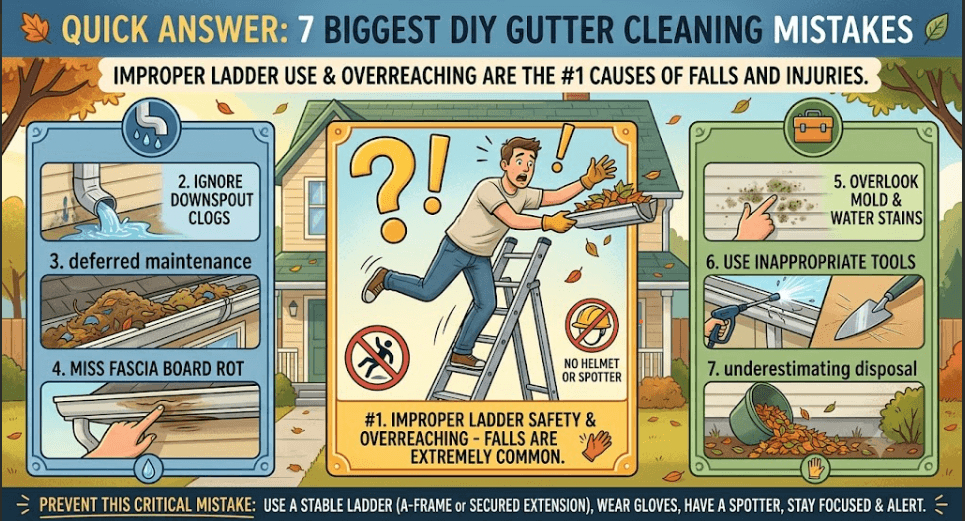
The most common mistake is cleaning gutters without checking the downspouts and slope afterward. Homeowners scoop out leaves, call it done, and miss the clogged elbow joint or sagging section that causes water to back up during the next storm. A proper cleaning job always ends with a water flow test, not just a visual check.
Mistake #1: Skipping the Downspout Flush
Most DIY cleanings stop at the gutter trough. People pull out visible debris and never flush water through the downspout to confirm it drains. A blocked downspout elbow can hold water in the gutter system even after the trough looks clean, which leads to overflow at the seams and rust spots over time. Downspout realignment is often needed after winter freeze-thaw cycles shift the joints, and that’s something a visual-only cleaning will miss.
Mistake #2: Using the Wrong Ladder Setup
Peoria’s older neighborhoods have a mix of steep-pitched roofs and soft ground near foundation beds, and a lot of ladder accidents happen because homeowners lean the ladder directly against the gutter instead of the fascia board or roofline. This bends aluminum gutters, pulls fasteners loose, and creates a false sense of stability on uneven yards. A stabilizer bar that rests against the roof edge, not the gutter lip, prevents most of this damage.
Mistake #3: Cleaning at the Wrong Time of Year
Illinois weather doesn’t give you one clean window. Peoria gets two heavy debris seasons: oak and maple leaf drop in fall, and seed pods plus spring storm debris in April and May, right when the region’s average 36 inches of annual rainfall hits its wettest stretch. Homeowners who clean only once in November leave their systems unprotected for spring flooding season, when clogged gutters do the most foundation damage.
Mistake #4: Ignoring Fascia Board Rot
Standing on a ladder and scooping debris doesn’t give you a clear view of what’s happening behind the gutter. Fascia board rot develops quietly when water sits against wood trim for months, and by the time it’s visible from the ground, the board is often too soft to hold gutter hangers. If you notice soft spots, dark staining, or a gutter section pulling away from the roofline, that’s a repair issue, not a cleaning one. Our gutter repair Peoria IL team handles this separately from routine cleanings for exactly this reason.
Mistake #5: Not Checking Gutter Slope
Gutters need a slight pitch, roughly a quarter-inch of drop for every 10 feet, to move water toward the downspout. DIY cleanings rarely include a slope check, so a section that’s sagged or leveled out over the years keeps collecting standing water even after every leaf is gone. Standing water in aluminum gutters speeds up corrosion and creates the perfect breeding ground for mosquitoes during Peoria summers.
Mistake #6: Overlooking Gutter Guards During Cleaning
Homes with gutter guards still need periodic cleaning, but a lot of homeowners either skip it entirely, assuming the guards handle everything, or remove and reinstall the guards incorrectly, leaving gaps where small debris gets in. Mesh and foam-style guards clog with pine needles and seed pods over time even though they block larger leaves. If your home has guards installed, check the manufacturer’s maintenance schedule; most residential gutter guard systems still need an annual inspection.
Mistake #7: Skipping the Post-Cleaning Inspection
The cleaning itself is only half the job. A thorough gutter check also means inspecting seams for leaks, checking hangers for looseness, and confirming downspout extensions are still directing water at least 3 feet away from the foundation. Homeowners who skip this step often discover the real problem, a cracked seam or loose hanger, only after the next heavy rain floods a section of yard or basement wall.
Why These Mistakes Add Up in Peoria Specifically
Central Illinois weather is harder on gutter systems than most regions realize. Freeze-thaw cycles through winter loosen fasteners and joints. Spring rainfall stresses any weak point in the system immediately. And heavy tree cover in neighborhoods near the bluffs means debris accumulates fast between cleanings. A single missed step, whether it’s a downspout flush or a slope check, tends to surface as a bigger problem within one season rather than years down the line.
If your gutters back up, sag, or overflow at the seams no matter how often you clean them, the issue is often structural rather than a debris problem. Our team handles full <a href=”https://guttercleaningpeoria.com/gutter-installation-peoria-il/”>gutter installation in Peoria, IL</a> when a system is too far gone to keep patching, and we offer <a href=”https://guttercleaningpeoria.com/gutter-guard-installation-peoria-il/”>gutter guard installation for Peoria homes</a> that want to cut down on how often cleaning is needed in the first place.
For homeowners weighing DIY against hiring it out, the EPA’s guidance on managing stormwater runoff around your home is a useful reference for understanding how gutter and downspout placement affects water flow around your property.
FAQs
How often should I clean my gutters in Peoria?
Twice a year at minimum, once in late fall after leaves drop and once in early spring before the wettest months hit. Homes with heavy tree cover nearby may need a third cleaning in early summer.
Can I clean gutters myself, or should I hire a professional?
Single-story homes with easy roof access are reasonable for a careful DIY cleaning. Two-story homes, steep rooflines, or gutters near power lines are safety risks better left to a trained crew with proper equipment.
How often should I clean my gutters in Peoria?
Look for dark water stains below the gutter line, soft or spongy wood when pressed, and gutters that sag or pull away from the roof edge. Any of these signs means it’s time for an inspection rather than another cleaning.
What’s the average cost of professional gutter cleaning in Peoria?
Most single-story homes run $99 to $149, while two-story and larger homes typically fall between $149 and $229, depending on linear footage and roof pitch.
Do gutter guards eliminate the need for cleaning?
No. Gutter guards reduce how often you need to clean but don’t eliminate it. Most systems still need an annual check for small debris buildup and guard alignment.
What happens if I never clean my gutters?
Clogged gutters overflow during rain, sending water straight down your foundation instead of away from it. Over time this leads to cracked foundations, basement leaks, and fascia or soffit rot, repairs that cost far more than routine cleaning.
Is spring or fall more important for gutter cleaning in Peoria?
Both matter, but fall cleaning is critical because leftover leaves freeze into ice dams during winter. Spring cleaning matters just as much since Peoria’s heaviest rainfall hits in April and May.
Serving the greater Peoria community, including Peoria Heights, East Peoria, Pekin, Dunlap, Bellevue, and Bartonville. Call (309) 320-0930 for a free estimate.