
If you’ve ever noticed a section of your gutter overflowing while the rest of the run stays dry, the roof valley above it is usually the reason. A roof valley is where two roof slopes meet at an angle, and it channels far more water than any other part of your roof. When that water dumps into a standard gutter section that wasn’t built to handle the volume, you get overflow, fascia rot, and foundation problems long before the rest of your gutter system shows any strain. For homeowners handling gutter cleaning in Peoria, the valley-to-gutter junction deserves more frequent inspection than any other spot on the house.
Table of Contents
Quick Answer: What Makes Roof Valley Gutters Different
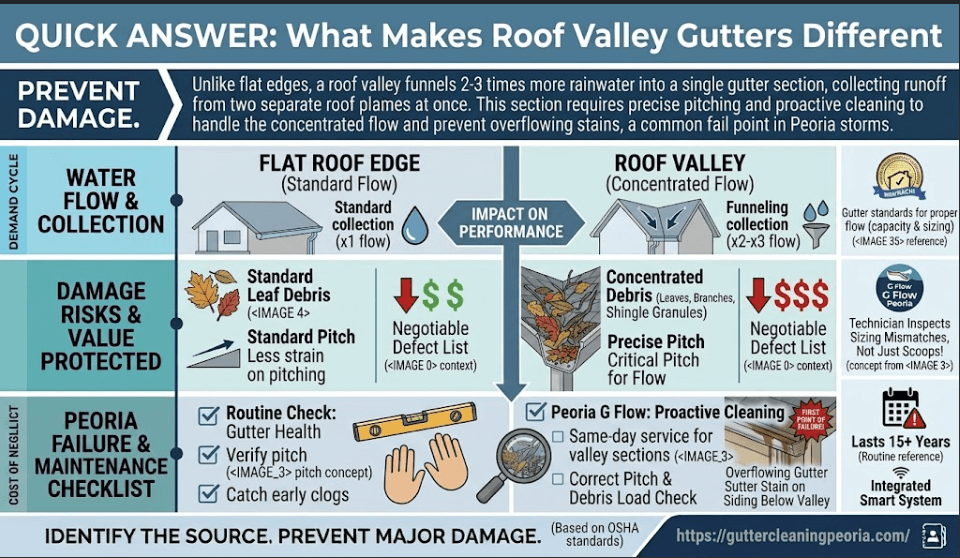
A roof valley can funnel two to three times more rainwater into a single gutter section than a flat roof edge, because it collects runoff from two separate roof planes at once. During a heavy Peoria thunderstorm, that concentrated flow arrives fast and carries more debris — shingle granules, leaf litter, and small branches — than any other section of the gutter. If that segment isn’t cleaned and pitched correctly, it becomes the first point of failure on the entire system, usually showing up as an overflow stain on the siding directly below it.
Why Valleys Overload Gutters Faster Than Anywhere Else
Picture the roof as a funnel. Every valley acts like a chute that pulls water from two slopes and pours it into one narrow stretch of gutter. On a typical Peoria home with a gable or hip roof, that means the gutter section sitting under a valley can see double or triple the water volume of a straight run during a downpour. Add central Illinois’ seasonal pattern of ice, thaw, and spring storms, and that same stretch of gutter also collects the heaviest load of granules, twigs, and matted leaves washed down from the valley above.
That combination — high water volume plus concentrated debris — is why valley-adjacent gutters clog first and clog worst. A gutter that looks clear everywhere else can still be packed solid right under the valley, and that’s usually the spot causing the water stain nobody can explain.
Warning Signs Specific to the Valley-Gutter Junction
- Overflow directly below one valley, nowhere else on the roofline — a clear signal that section is undersized or blocked.
- Granule buildup or a sandy residue collecting in the gutter trough under the valley.
- Sagging or pulling gutter hangers in that one section, caused by the extra weight of trapped water and debris.
- Fascia board staining or soft spots directly beneath the valley outlet.
- Ice buildup that forms first and melts last at that junction during winter, a sign water is sitting rather than draining.
Local Factors That Make This Worse in Peoria
Peoria’s mix of heavy spring rain events and older tree canopy in neighborhoods like the West Bluff and North Peoria means valley areas collect leaf and seed debris faster than newer subdivisions with less mature landscaping. The city’s own stormwater program notes that impervious surfaces, including roofs, are a major contributor to runoff volume during storm events, which is exactly why a clogged valley-gutter junction can send more water toward your foundation than most homeowners expect. You can review how the city manages this runoff on its <a href=”https://www.peoriagov.org/539/Stormwater-Overview”>stormwater overview page</a>.
Freeze-thaw cycles common to central Illinois winters also matter here. Water that pools at a clogged valley outlet freezes overnight, expands, and can pull gutter seams and hangers apart faster than a straight, evenly draining section ever would.
What Proper Valley Flashing and Gutter Sizing Should Look Like
The flashing under a valley needs to direct water cleanly into the gutter without letting it slide behind the fascia, and the gutter section itself often needs a wider trough or an added downspout nearby to keep pace with the volume. Manufacturer guidance on valley flashing methods, including woven and open valley techniques, outlines why a poorly built valley is one of the hardest roof defects to fix after the fact — see GAF’s <a href=”https://www.gaf.com/en-us/document-library/documents/technical-bulletins-&-notes/r-136-valley-flashing-options.pdf”>valley flashing options bulletin</a> for the technical breakdown. If your gutters were installed as a uniform system without accounting for valley placement, that mismatch is often the root cause of repeat overflow complaints.
A Practical Maintenance Schedule for Valley-Adjacent Gutters
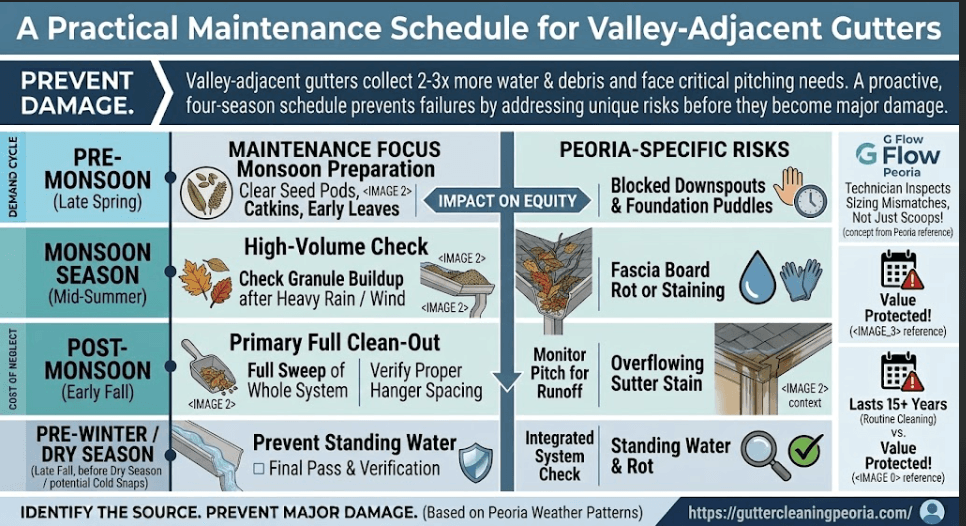
- Late spring — clear seed pods, catkins, and early leaf drop that build up faster near valleys.
- Mid-summer — check for granule buildup after any hailstorm or high-wind event, since valleys catch more shingle wear.
- Early fall — full clean-out before leaf season, focusing extra time on valley sections rather than a uniform sweep.
- Late fall, before freeze — a final pass to prevent standing water from turning into ice dams at the junction.
Homeowners who only schedule one cleaning a year almost always pick the fall, which misses the spring and summer debris that settles specifically at valley outlets. A four-season approach, or at minimum a spring-and-fall combination, keeps that high-volume section from becoming the point of failure.
When to Call a Professional Instead of DIY
Valley sections sit at odd angles and often over the steepest or highest part of the roof, which makes ladder access more dangerous than a standard gutter run. If you’re seeing repeat overflow at one specific spot, sagging hangers, or fascia staining that keeps coming back after you clean it yourself, that’s a sign the flashing, gutter pitch, or downspout placement needs a professional look rather than another round of scooping leaves. A same-day inspection can usually tell you whether the fix is a simple debris clear-out or a flashing and gutter reconfiguration.
Our team handles this exact issue across the area, and if you want it looked at before the next storm rolls through, guttercleaningpeoria.com is the fastest way to get a technician scheduled for a valley-focused inspection.
FAQs
How often should roof valley gutters be cleaned compared to the rest of the system?
Valley sections should be checked at least twice as often as straight gutter runs — ideally every season — because they collect more debris and carry more water volume than any other part of the roofline.
Can a clogged valley gutter cause roof leaks, not just gutter overflow?
Yes. When water backs up at a blocked valley outlet, it can work its way under the shingles or flashing above the clog, leading to interior leaks that show up as ceiling stains well away from the gutter itself.
Is it normal for one section of gutter to overflow while the rest stays dry?
It’s common, and it almost always points to a valley, downspout, or pitch issue in that specific section rather than a problem with the whole system.
Do I need a wider gutter or extra downspout under a roof valley?
Many valley sections benefit from an oversized trough or an additional downspout nearby, since standard gutter sizing is often calculated for average roof runoff, not the concentrated flow a valley produces.
How does Peoria’s weather specifically affect valley gutters?
Central Illinois’ pattern of heavy spring storms followed by freeze-thaw winters means valley sections deal with both high-volume runoff and repeated ice expansion, which is a harder combination on gutters than either factor alone.
What’s the fastest way to tell if my valley gutter needs professional attention?
If cleaning it yourself doesn’t stop the overflow, or the same section clogs again within a few weeks, the flashing or gutter pitch likely needs adjustment rather than another cleaning.