
Gutter cleaning Peoria homeowners need can vary depending on their roof pitch, gutter size, and drainage system. A steep roof can send water into gutters with greater speed and volume, while low-slope roofs may allow leaves, dirt, and other debris to settle longer. Understanding how roof pitch affects gutter sizing and cleaning frequency can help Peoria homeowners prevent overflowing gutters, fascia damage, and foundation drainage problems.
Table of Contents
Quick Answer: Does Roof Pitch Really Change Gutter Needs?
Yes. A steeper roof pitch sheds water faster and with more force, which means it needs a larger gutter (or additional downspouts) to handle peak flow without overflowing. As a general rule, roofs with a pitch steeper than 6/12 push water off the edge at speeds that overwhelm a standard 5-inch K-style gutter during heavy rain, while low-slope roofs (under 4/12) move water more slowly but tend to hold debris longer, which raises the need for more frequent cleaning. Both extremes require different maintenance schedules — steep roofs need gutters checked after every major storm, while low-pitch roofs need cleaning on a tighter seasonal calendar to prevent standing water.
Why Roof Pitch Changes the Math on Gutter Sizing
Roof pitch is measured as rise over run — a 6/12 pitch rises 6 inches for every 12 inches of horizontal run. The steeper that number, the faster rainwater accelerates down the roof surface before it reaches the gutter. Higher velocity water carries more force and volume per second, and a gutter that’s too narrow simply can’t catch it all.
Here’s how pitch typically maps to gutter sizing needs:
- Low pitch (2/12 to 4/12): Water moves slowly and pools in valleys. Standard 5-inch gutters usually work, but debris accumulates faster because water doesn’t have enough force to flush leaves and grit through the system.
- Medium pitch (5/12 to 8/12): This is the most common range on Peoria homes. A 5-inch or 6-inch K-style gutter with properly spaced hangers generally handles the flow, assuming downspouts are sized correctly.
- Steep pitch (9/12 and above): Water hits the gutter with significant force and volume. Homes with steep or multi-story rooflines often need 6-inch gutters and oversized 3×4-inch downspouts to avoid overshoot, where water literally jumps past the gutter during downpours.
Roof surface area matters just as much as pitch. A steep roof with a large surface area concentrates enormous volumes of water into a short window during a storm, which is why homes with dramatic rooflines in neighborhoods around Peoria often need custom downspout placement rather than the builder-standard layout.

How Cleaning Frequency Shifts With Pitch
Gutter sizing gets the attention, but cleaning frequency is just as pitch-dependent, and it’s the part most homeowners overlook.
Steep roofs (9/12+): Debris tends to get flushed downhill quickly, so leaves and shingle grit don’t sit as long. However, the force of the water can pack debris hard against gutter guards and downspout openings, creating stubborn clogs that build gradually and go unnoticed until an overflow event. These roofs benefit from an inspection after any storm dumping more than an inch of rain in an hour.
Low-slope roofs (under 4/12): Water drains slowly, so leaves, seed pods, and dirt settle and stay put. Standing water in a low-pitch gutter run breeds mosquito larvae and accelerates rust on metal fasteners. These roofs need cleaning on a stricter seasonal schedule, typically twice a year at minimum, and more often near mature trees.
Medium pitch roofs: These generally follow the standard twice-a-year cleaning schedule — once in late spring after seed pods and helicopter debris fall, and again in late autumn after leaf drop.
Peoria-Specific Factors That Compound Pitch Issues
Central Illinois weather adds pressure on top of whatever your roof pitch already dictates. Peoria sees heavy spring thunderstorms capable of dropping an inch or more of rain in under an hour, which stress-tests any gutter system regardless of size. Combine that with the region’s mature oak and maple tree cover, and even a well-sized gutter on a steep roof can clog fast during fall leaf drop.
Winter freeze-thaw cycles are the other local variable. When gutters on lower-pitch roofs hold standing water into November, that water freezes, expands, and pulls fasteners loose from the fascia board — a problem that shows up as sagging gutters the following spring. Homes with steep pitches are less prone to standing water but more prone to ice buildup at the roof edge when heavy snow melts and refreezes overnight, a pattern common during Peoria’s typical January thaw-freeze swings.
Warning Signs Your Gutter Size Doesn’t Match Your Roof Pitch
- Water sheeting over the front edge of the gutter during moderate rain, not just downpours
- Splash-back staining on siding directly below roof valleys
- Downspouts that gurgle or back up within minutes of rain starting
- Visible sagging or pulling-away sections near high-pitch roof planes
- Standing water or silt buildup in gutter runs under low-slope sections
If you’re seeing any of these, the fix usually isn’t just a cleaning — it’s a sizing or downspout placement issue that a cleaning visit can properly diagnose.
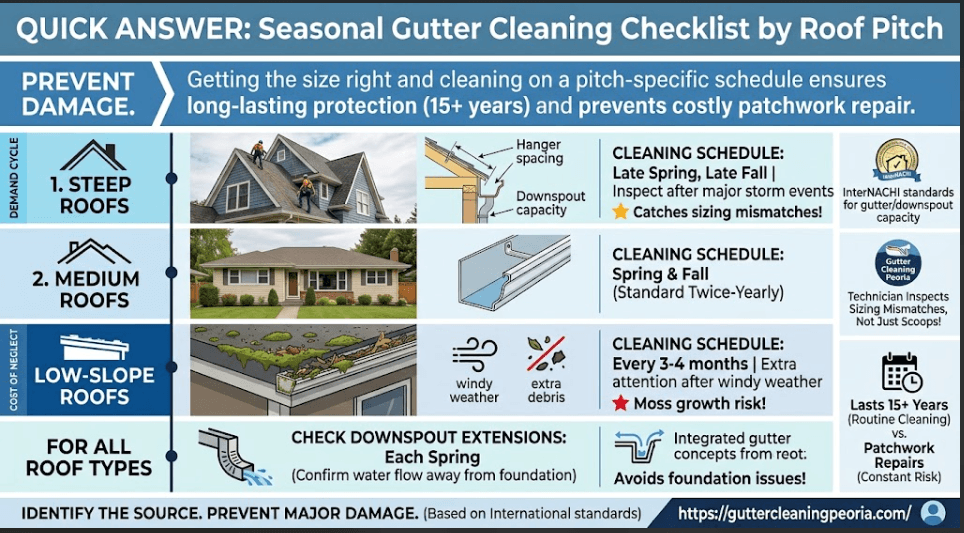
Seasonal Cleaning Checklist by Pitch Type
- Steep roofs: Inspect after every major storm event; full cleaning in late spring and late fall.
- Medium roofs: Standard twice-yearly cleaning, spring and fall.
- Low-slope roofs: Cleaning every 3-4 months, with extra attention after windy weather that drops debris.
- All roof types: Check downspout extensions each spring to confirm water is still being carried away from the foundation.
For homeowners who’d rather not climb a ladder to check pitch-specific wear points, scheduling routine gutter cleaning in Peoria with a technician who inspects hanger spacing and downspout capacity — not just scoops leaves — catches sizing mismatches before they become fascia repairs. Reference guides like the International Association of Certified Home Inspectors’ gutter and downspout standards outline the same pitch-to-flow principles professionals use when evaluating whether a gutter system is actually adequate for a given roofline.
Getting the size right the first time, and cleaning on a schedule that matches your specific pitch, is the difference between a gutter system that lasts fifteen-plus years and one that needs constant patchwork repair.
Frequently Asked Questions
Does a steeper roof always need bigger gutters?
Not automatically, but it usually does once the roof surface area is large enough to generate significant water volume. A small steep roof section may still work fine with a standard 5-inch gutter; a large steep roofline almost always needs a 6-inch gutter and wider downspouts.
Can I mix gutter sizes on the same house if pitch varies by section?
Yes, and it’s often the correct approach. Homes with mixed rooflines — a steep front gable and a lower-pitch rear addition, for example — frequently need different gutter and downspout sizing on each section to handle the different flow rates correctly.
How do I know if my current gutters are undersized for my roof pitch?
Overflow during moderate (not just extreme) rain, water pooling and dripping mid-span rather than at the downspout, and staining on the fascia board are the clearest signs. A physical inspection during a rain event is the most reliable way to confirm it.
Does gutter guard installation change how often I need cleaning based on pitch?
Guards reduce debris load but don’t eliminate cleaning needs, especially on low-pitch roofs where fine grit and seed debris can still pass through mesh guards and settle in slow-moving water.
Is 5-inch or 6-inch gutter better for a typical Peoria home?
Most standard-pitch homes in the area do fine with 5-inch K-style gutters. Homes with steep or complex rooflines, large roof surface areas, or a history of overflow issues generally benefit from upgrading to 6-inch gutters with 3×4-inch downspouts.
How often should low-slope roof gutters be cleaned compared to steep roofs?
Low-slope roofs typically need cleaning every 3-4 months because debris settles rather than washing through. Steep roofs can often go on a standard twice-yearly schedule but need a post-storm visual check after significant rain events.
Can incorrect gutter sizing cause foundation problems?
Yes. Undersized gutters overflow near the foundation line rather than channeling water through the downspout system, which over time saturates soil next to the foundation and can lead to settling or basement moisture issues.
Serving the greater Peoria community with routine and seasonal gutter maintenance. For a pitch-specific inspection and cleaning plan tailored to your roofline, contact our Peoria gutter cleaning team to schedule service.