
Not all gutters collect debris at the same rate, and the material on your roofline plays a bigger role than most homeowners realize. If you’ve been searching for gutter cleaning in Peoria because your downspouts keep clogging faster than your neighbor’s, the answer often comes down to what your gutters are made of. Aluminum, vinyl, steel, and copper each shed debris, hold water, and resist sagging differently — which changes how often you need a crew out to clear them.
Table of Contents
Quick Answer: How Often Should You Clean Gutters Based on Material?
Vinyl and standard aluminum gutters typically need cleaning 2 to 3 times a year in Peoria because their smoother interiors still allow debris to catch at seams and hangers. Seamless aluminum gutters, which dominate most Peoria homes, can often stretch to 2 cleanings a year since they have no interior seams for leaves and grit to snag on. Steel and copper gutters, while more rigid and rust-resistant, tend to develop rough surface texture over time that grabs debris faster, pushing some properties toward 3 to 4 cleanings annually — especially under heavy tree canopy.

Why Gutter Material Changes Your Cleaning Frequency in Peoria
Peoria’s mix of spring storms, humid summers, and heavy tree cover means every gutter system works hard year-round. But the material determines how that workload shows up as clogs, sagging, or a faulty compressor-style breakdown — except here it’s a downspout backup instead of an appliance failure. Here’s how the most common materials compare.
Seamless Aluminum Gutters
Seamless gutters are formed on-site to match your roofline exactly, which eliminates the joints where leaf litter and shingle grit typically build up. This is why most professional crews recommend only two cleanings a year for seamless aluminum — usually late spring and late fall. The tradeoff is that aluminum dents easily under heavy ice buildup, so winter inspections still matter even if you’re not scheduling a full cleaning.
Sectional Aluminum Gutters
Sectional gutters use overlapping joints every 10 feet or so. Those joints are where clogs start, since small twigs and seed pods wedge into the seams before spreading into a full blockage. Homes with sectional aluminum should plan on 3 cleanings a year, with an added downspout realignment check each fall to make sure joint movement hasn’t thrown off the water flow.
Vinyl Gutters
Vinyl is lightweight and budget-friendly, but it expands and contracts more than metal with Peoria’s temperature swings — from summer highs near 82°F to winter lows well below freezing. That movement can widen seams over a few seasons, creating more debris traps than the material had when new. Expect 3 cleanings a year on vinyl, with closer attention to hanger spacing since vinyl sags faster under wet leaf weight than aluminum or steel.
Steel and Galvanized Gutters
Steel holds up well against impact and ladder traffic, but its slightly textured surface catches organic debris faster than smooth aluminum. Combined with Peoria’s humid summers, trapped moisture in steel gutters can accelerate rust at the seams if cleaning is delayed. Most steel systems need 3 to 4 cleanings a year, particularly on properties near the bluff neighborhoods where dense oak and silver maple canopies drop heavy debris loads each fall.
Copper Gutters
Copper is the most durable option, often lasting 50 years or more, but the same slightly rougher surface texture that gives copper its longevity also means it holds onto grit and organic buildup a bit longer than aluminum. Two to three cleanings a year is standard, though copper’s rigidity makes it more forgiving of Peoria’s freeze-thaw cycles than vinyl or lightweight aluminum.
Local Factors That Push Cleaning Frequency Higher — Regardless of Material
Peoria’s climate adds pressure on top of whatever material you have installed:
- Spring storm season: Peoria averages roughly 36 to 41 inches of precipitation a year, with the wettest stretch landing in late spring. A gutter that’s even partially clogged going into a heavy spring storm is far more likely to overflow and cause fascia board rot along the roofline.
- Heavy tree canopy: Neighborhoods with mature silver maple and oak trees — common across the East Bluff, West Bluff, and Richwoods areas — see faster debris accumulation than newer subdivisions with younger landscaping.
- Freeze-thaw cycles: Peoria winters regularly swing between the low 20s and below zero. Standing water in a clogged gutter that freezes and expands is one of the fastest ways to pull hangers loose or crack seams, regardless of material.
- Summer humidity: Trapped organic debris breaks down faster in humid summer conditions, turning dry leaves into dense sludge that’s harder to clear and can support mosquito breeding if left too long.
Signs Your Gutters Need Cleaning Sooner Than Scheduled
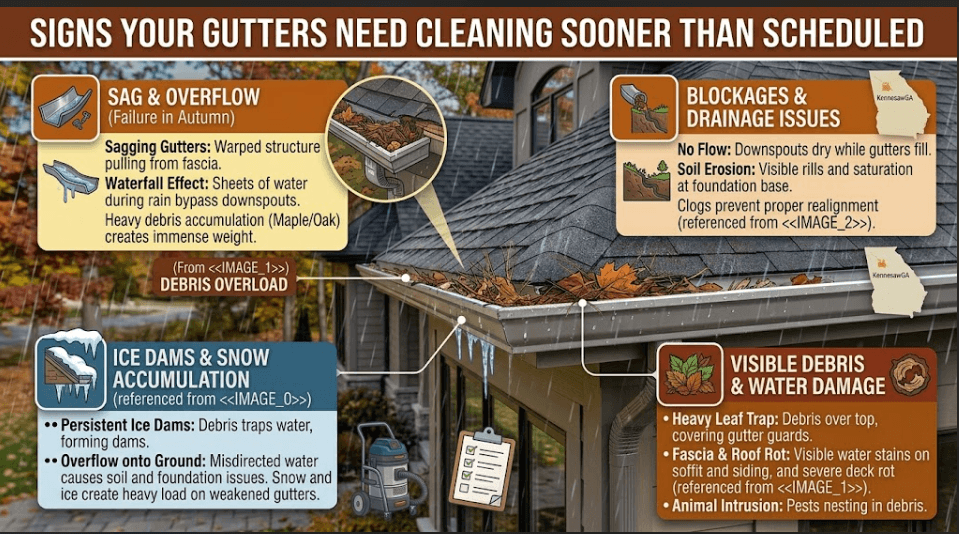
- Water visibly overflowing during moderate rain, not just downpours
- Sagging sections or visible gaps between the gutter and fascia board
- Plant growth or standing water inside the trough
- Water stains or streaking on siding below the gutter line
- Downspouts releasing a slow trickle instead of a steady flow
If you’re noticing two or more of these signs, it’s worth moving up your next cleaning rather than waiting for the next scheduled visit. A same-day inspection can usually confirm whether it’s a simple clog or a sign of water damage that needs repair.
Cost Considerations by Material and Frequency
Cleaning cost scales with how often a material needs service, not just the size of the home. Seamless aluminum’s lower cleaning frequency generally makes it the most cost-effective option over a 10-year span, even though sectional and vinyl systems sometimes cost less upfront. Steel and copper carry higher per-visit costs due to added weight and handling, but their extended lifespan can offset that over time. A property manager weighing new installation against continued maintenance should factor in both the material’s typical lifespan and how many cleanings it will realistically need each year in Peoria’s climate.
For homeowners comparing options, our team offers straightforward quotes for professional gutter cleaning in Peoria based on your specific material, roofline, and tree coverage — not a flat one-size-fits-all rate.
When to Call a Professional vs. DIY
Ground-level ranch homes with simple rooflines and seamless aluminum gutters are reasonable DIY candidates for light debris removal. Two-story homes, steep bluff-lot properties, or anything with steel or copper gutters are better left to a crew with proper ladder stabilization and safety equipment. If you’re seeing consistent overflow or suspect a downspout is fully blocked underground, it’s worth having seamless gutter cleaning and inspection in Peoria handled professionally so small issues don’t turn into fascia or foundation repairs.
For guidance on stormwater and downspout drainage requirements around your property, Peoria County’s stormwater management guidelines outline requirements for redirecting downspout discharge away from shared drainage areas. For general climate data referenced in this guide, the National Weather Service publishes historical precipitation and snowfall records for the Peoria area.
If your gutters are overdue and you’d rather not risk a weekend on a ladder, request a Peoria gutter cleaning estimate and get a same-week appointment based on your material and roofline.
Frequently Asked Questions
How often should gutters be cleaned in Peoria, Illinois?
Most homes need cleaning 2 to 3 times a year, timed around late spring after tree pollen and seed pods drop, and late fall after leaf season. Homes with heavy tree canopy or older sectional gutters often need a third cleaning in mid-summer.
Does gutter material really change how often I need cleaning?
Yes. Seamless aluminum has no interior joints for debris to catch on, so it typically needs fewer cleanings than sectional aluminum, vinyl, steel, or copper systems, which all have seams or textured surfaces that trap debris faster.
What’s the difference between sectional and seamless gutters?
Sectional gutters are installed in pre-cut lengths joined together on-site, creating seams every several feet. Seamless gutters are custom-formed to your roofline in one continuous piece, eliminating those joint-related clog points.
Can clogged gutters cause water damage to my home?
Yes. Overflow from clogged gutters is one of the leading causes of fascia board rot, foundation erosion, and basement moisture intrusion, especially during Peoria’s heavy spring storm season.
Do gutter guards eliminate the need for cleaning?
No. Gutter guards reduce large debris accumulation but don’t stop fine grit, seed pods, or ice buildup. Most guarded systems still need an annual inspection and light cleaning.
How much does gutter cleaning cost in Peoria?
Pricing depends on linear footage, roof pitch, number of stories, and gutter material, since steel and copper systems take longer to service safely than lightweight aluminum. Request a quote based on your specific property for an accurate number.
Is it safe to clean gutters myself?
For single-story homes with simple rooflines, light debris removal is manageable with proper ladder safety. Multi-story homes, steep bluff lots, or gutters showing sagging or separation are safer left to a professional crew with the right equipment.